The hold stank of brine and rot and something underneath that the sailors hadn’t found yet, though they would soon enough.
Riasean had learned to breathe through his mouth on the second day. By the ninth, he’d stopped noticing the smell at all, which frightened him more than the smell itself had — how quickly a body learned to stop objecting to the unbearable, if the unbearable simply persisted long enough. He knew that lesson from before the ship. He hadn’t expected to relearn it in a box built for grain.
He heard Tenoach before he saw it — the particular clatter of a working port at night, chains and shouted orders and the groan of a hull easing against a dock built to take it. Different words than the ones he’d grown up hearing. Different rhythm to them. He pressed his ear to the planking anyway, as if the sound might tell him something about what waited beyond it.
It was the light that found him first. A lantern, pushed through the hatch ahead of a man’s arm, throwing his shadow huge and wrong across the sacks he’d hollowed out to hide among. Riasean didn’t move. Moving was a decision, and he hadn’t made one yet.
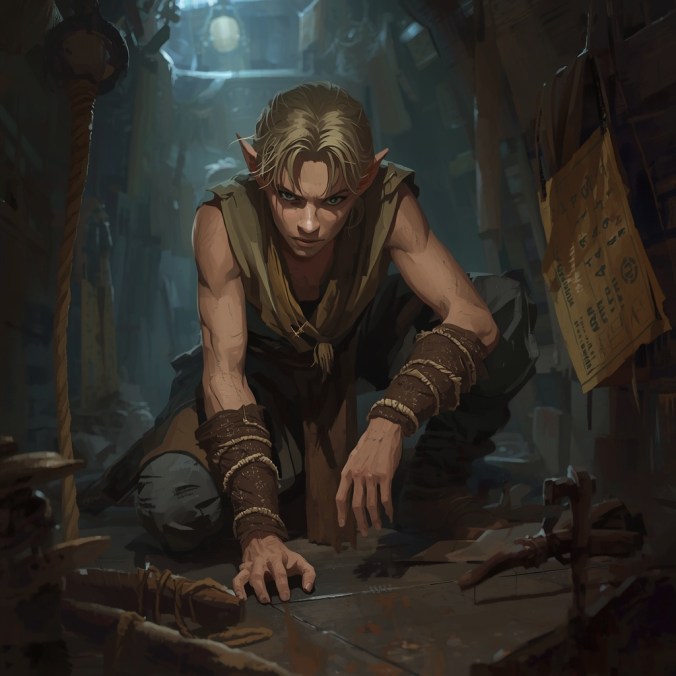
“Well,” the man said, in the port-tongue Riasean had spent the crossing teaching himself out of overheard scraps. “Look what the tide dragged up.”
Two more shapes crowded the hatch behind him. Riasean did the arithmetic without meaning to — distance, angles, which one would reach him first, what was still sharp enough on him to matter. His hand had already found the shard of iron he’d kept close since the fourth night, since the crewman who’d nearly caught him and hadn’t lived to tell it.
“Easy,” the first man said, reading something in how Riasean held himself that made him stop advancing. “Nobody said kill it. Yet.” He glanced back over his shoulder, to whoever waited above. “Elf-blood. Half of one, anyway. Look at the ears under all that filth.”
“Slave-marked,” the second added, crouching to get a better look, careless in the way of a man who’d already decided the thing in front of him wasn’t quite a person. He tipped Riasean’s shoulder with two fingers, enough to catch the old scarring there in the lantern light — long-healed stripes, laid one over another, the kind that only came from years of it. “Somebody worked him a good long while before he ran.”
They talked about him like weather. Riasean had heard that particular register his whole life. The tone people used for a body they hadn’t yet decided the value of and something in him went very still and very cold, the way it always did right before he stopped being afraid and started being dangerous.
“Fetch him up,” the first man said, finally, straightening. “Let somebody who cares about profit decide what he’s worth.”
They didn’t ask his name. Nobody had asked his name since the crossing began, and it occurred to Riasean, as they hauled him blinking into the lantern light and the wet dark of a foreign harbor, that he’d nearly forgotten he still had one.
* * *
They walked him up through the belly of the ship and out onto a dock lit by torches instead of the lanterns Riasean was used to, and the noise of Tenoach hit him full in the chest — voices in three languages he half-knew, the wet slap of cargo nets, somewhere a woman laughing at something that wasn’t funny. He kept his shoulders low. He’d learned that trick, too. Small things drew less attention than things that stood their ground.
They brought him not to a dockmaster or a guard captain, but to a man standing apart from the working chaos of the pier, unbothered by it, the way a stone is unbothered by a river running around it.
He was older than Riasean expected — not old, but weathered in a deliberate way, like a blade kept sharp rather than kept new. His left hand ended in a curved hook of dark iron, worn smooth at the bend from years of use, and he carried it the way another man might carry a hand that still had feeling in it — unselfconscious, put to work without ceremony. He didn’t come closer right away. He looked at Riasean the way the sailors had looked at cargo manifests, except worse, because there was no carelessness in it at all. Every part of the look was doing work.
“This the one from the hold?” the man asked the sailors, though his eyes didn’t leave Riasean.
“Stowed nine days, best we can tell. Killed Ferris getting this far, or near enough — Ferris went missing round the fourth night and didn’t turn up drowned.” One of them said it almost admiringly, the way men speak of a dog that’s bitten someone they didn’t like. “Elf-blood. Slave-marked bad, look at his back.”
The man — Coronados, though Riasean wouldn’t have a name to put to him for another hour yet — finally moved. Not toward Riasean’s face. He circled, slow, unhurried, the way you’d walk a horse you were deciding whether to buy and stopped behind him. The hook rose, almost idle, and hooked the collar of Riasean’s shirt, drawing the fabric aside just enough to see the old scarring beneath — a gesture with no violence in it at all, which was somehow worse than if there had been. Riasean felt the weight of the look land on his shoulders and did not flinch, though it cost him something not to.
“Tamor taught this one a lesson,” Coronados said, almost to himself, letting the collar fall back into place. Not a question. Not sympathy, either — just a man confirming an entry against what he already knew. “You ran the whole crossing on rations meant for four, and you’re still standing. And you put down a grown sailor with your hands, half-starved, in the dark, in a space you couldn’t stand up in.”
Riasean said nothing. Speaking felt like handing over something he might need later.
Coronados came back around to face him properly for the first time. Up close, his eyes were doing arithmetic of their own — Riasean could feel it, the specific sensation of being measured by someone who dealt exclusively in what people were worth, and never in what they’d suffered to become it. The hook hung at his side, still, patient, a tool at rest.
“What’s your name?” Coronados asked. Not who owned you. Not where are you from? Not what are you running from? The absence of those questions landed harder than if he’d asked them.
It took Riasean a moment to find the answer, because it had been so long since anyone had wanted it for its own sake.
“Riasean,” he said.
Coronados nodded once, like a man closing a ledger. “Get him fed,” he said, to no one and everyone. “Then bring him to me. I want to see what he does when he isn’t starving.”
He turned and walked back into Tenoach without waiting to see if the order was obeyed, entirely certain that it would be.
* * *
They fed him in a back room that smelled of tallow and old smoke, and Riasean ate the way a starved animal eats — fast, hunched, one arm curved protectively around the bowl, though no one moved to take it from him. Nobody spoke to him while he did it. He was grateful for that more than for the food itself.
When they brought him to Coronados again, it was in a narrow yard behind the building, walled high enough that the noise of the port fell away to a murmur. A single lantern hung from a hook driven into the stone. Riasean noticed, distantly, that someone had thought to hang it at exactly the height Coronados’s own hook would reach without him needing to look.
Coronados was not alone. A second man stood beside him, restrained, wrists bound in front of him with the particular economy of someone who did this often and Riasean recognized him before his mind caught up to why. The set of the shoulders. The half-healed cut along one forearm, from the fourth night, from the dark of the hold.
Ferris. Not dead, then. Only found, and dragged here, and kept — for this.
“You’ll remember him,” Coronados said, mild, as though introducing two acquaintances. “He remembers you. Says you left him for dead in a grain hold and he had to swim the better part of a mile to shore, furious the whole way, apparently, which I respect.” He didn’t look at Ferris while he said it. He looked at Riasean, gauging. “He wants payment. I told him I’d let the boy who did it decide the terms.”
Ferris spat something in port-tongue too fast for Riasean to follow, but the shape of it needed no translation. Rage. Humiliation. A man who’d nearly died to a starving boy and couldn’t live with what that said about him.
“He’s yours to settle,” Coronados said. “However you settle it. I won’t tell you how, and I won’t ask you why, after. I only want to see what you do when nobody’s making the choice for you.”
Riasean looked at Ferris — really looked, for the first time, not as an obstacle in the dark but as a man, angry and afraid and pretending not to be either. He thought of the sailors on the dock, talking about his back like weather. He thought of every time someone else had decided what he was for.
He didn’t reach for cruelty, though it was there, close enough to touch, and no one here would have blamed him for it. He stepped forward instead, took the black knife Coronados wordlessly offered handle-first from his good hand, and closed the distance.
Ferris wasn’t done yet. Bound wrists didn’t stop him from throwing his weight forward, shoulder first, trying to drive Riasean back into the wall before the blade found him. The last, ugly instinct of a man who’d rather die swinging than kneeling. Riasean took the impact against his hip instead of his center, let it turn him rather than fight it, and used the half-second that bought him. It wasn’t clean the way he’d wanted it to be. Ferris fought the whole way down, cursing, and it cost Riasean a shallow cut along the forearm to finish it. A fair trade, in the end, for a man who’d already made him bleed once before.
When it was over, Riasean crouched a moment longer than he needed to, catching his breath, before he wiped the blade — not on his own ruined shirt, but on Ferris, unhurried, the way another man might clean a tool on a rag and think nothing further of it. No message sent, exactly. But no ceremony spared for it, either.
Coronados noticed. Riasean saw him take note it. The smallest shift of attention, there and gone and understood, without being told, that something about the gesture had been filed away for later use.
Coronados studied him for a long moment, the lantern light catching the hook where it hung still at his side, and his eyes dropped once to the shallow cut on Riasean’s forearm before returning to his face. Something in his expression didn’t change so much as settle, like a scale finding its balance point.
“You bled for it,” he said, at last. Not a rebuke. Not quite approval either; an entry, made and closed. “Good. A boy who wins easy learns nothing from winning.” His gaze flicked to the blade, and to what Riasean had done with it after. “And you didn’t waste the mess on yourself. Small thing. Tells me more than the kill did.” He turned toward the door back into the building, hook tapping once against the frame as he passed through it, a habit worn smooth by years. “That’s rarer than you’d think, in this trade. Knowing which parts of a thing are worth keeping clean.”
He didn’t say welcome. He didn’t say well done. But he left the door open behind him, and didn’t look back to see if Riasean would follow.
Riasean followed.
* * *
The room Coronados brought him to was small, sparse, with more workspace than living quarters, consisting of a table, a single chair, and a wall of blades kept in better condition than anything else in the building. Riasean stood just inside the door, still bloodied, still nameless to everyone in Tenoach but the man in front of him.
Coronados moved to the table and set down a ledger, opening it one-handed, the hook holding the cover back with practiced ease. He didn’t look up right away.
“There’s a bounty standing on runaways out of Tamor,” he said, conversational, the way another man might mention weather. “Standing offer, good coin, no questions asked about condition. I could have you back across that water in a week and never think of it again.” He turned a page. “There’s men in this city who’d pay more for what you are than what you can do — elf-blood’s a curiosity in some houses. Novelty sells.”
Riasean said nothing. He’d learned that silence cost less than hope did.
“I’m telling you this,” Coronados said, finally looking up, “so you understand I’ve already decided against it. Not because it offends me. Very little does.” He closed the ledger. “Because you’re worth more to me standing in this room than sold in either direction. That’s the whole of my reasoning. I’d rather you heard it plain than imagined I felt something softer.”
It should have landed as cold. Riasean found, instead, that it was the first true thing anyone had told him since the escaping Tamor. Truth, even bloodless, sat easier on him than kindness ever had, because kindness always came with a bill he hadn’t yet been shown.
Coronados crossed the room, hook scraping once against the stone floor, and stopped an arm’s length away. He didn’t offer a hand — couldn’t, not the way other men did — but he unhooked a small black blade from his belt, plain, well-kept, and held it out grip-first.
“Nobody here will ask what you ran from,” he said. “Not because we don’t want to know. Because it doesn’t change what you’re for.” A pause, the closest thing to ceremony the man seemed to allow himself. “You’ll need a name that isn’t the one they hunt. Keep Riasean. It’s yours. Everything else, you can bury here, and nobody will dig it up.”
Riasean took the blade. His hand, he noticed, had stopped shaking somewhere between the yard and this room.
* * *
Later, sitting alone in a narrow room with a cot and a door locked to keep others out rather than to keep him in, Riasean turned the blade over in his hands. His thoughts drifted back to the hold, and the smell he’d stopped noticing, the ease with which a body learned to accept what it once would have called unbearable.
He had arrived in Tenoach as cargo, weighed and assessed on a dock by men who spoke of him like weather.
He left that yard as something else. Not saved. Not adopted. Chosen — the way a tool is chosen, deliberately, by someone who knows exactly what he intends to use it for.


Pingback: Works in progress… | Greg C. Miller, Author