The first thing Gall noticed about riding double was how impossible it was to maintain distance.
Not literally — his eyes could find the road ahead, the mountains, the sky. But she was tucked against him with the practical unavoidability of two people on one horse, and the careful peripheral management he’d been exercising for three days was no longer available to him. There was no peripheral. There was only this.
He kept his eyes forward and thought about the Mordwahl.
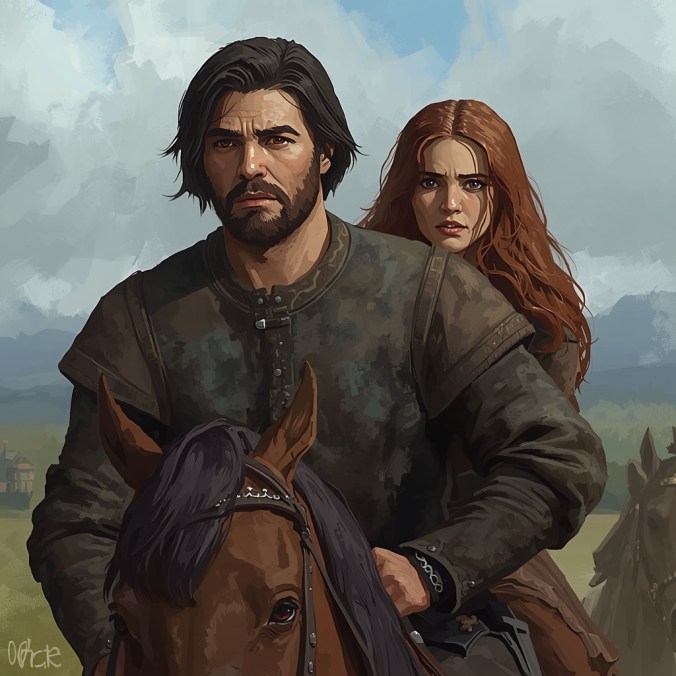
They stopped at midday beside a mountain stream to rest Dusk and eat. Aurea moved carefully getting down — her ribs still registering the persistence of healing bone — and he said nothing about it, which she took with the same matter-of-fact ease she took most things.
They ate in the comfortable quiet that had become their default, the stream loud enough beside them to fill the silence naturally.
“How long ago did you know her?” she said finally.
He didn’t ask who. “A long time.”
“How long?”
A pause. “Longer than you’d find comfortable.”
She looked at him then. He was watching the stream with the expression she’d come to read as his version of neutrality — carefully composed, which meant something was moving underneath it.
“You said you don’t need to sleep,” she said slowly. “You healed my wrist with your hands. Alric called you useful to the Caretakers for a very long time.” She paused. “How long is a very long time, Gall?”
He said nothing.
“My great-grandmother,” she said. “Not a grandmother. Not a mother. A great-grandmother.”
The stream ran over its stones with cheerful indifference.
“Yes,” he said finally.
He watched her absorb it — the confirmation landing differently than the reasoning, which he could see in the slight stillness that came over her, there and gone. She looked at the water for a moment.
“That’s why you tried not to come to me,” she said.
“I needed what you could do.”
“That’s not what I said.”
He looked at her then, and she met it without flinching, and after a moment something shifted in his expression — not much, but enough.
“No,” he said. “It isn’t.”
She nodded once and looked back at the water, and he let the silence stand.
That night was quieter than the ones before.
Not uncomfortably — they’d moved past discomfort somewhere on the road without quite marking the moment — but with a quality of awareness that hadn’t been there before the accident. She settled against him when the fire burned low with the same practical ease as the previous nights. He went very still when she did, the way he did every night, managing something he had no intention of naming.
He kept watch. The fire burned to coals. The stars moved overhead in their indifferent patterns.
Somewhere in the small hours, his mind went where it had no business going.
He had been careful. He was always careful. But careful required a quality of vigilance that the dark and the quiet and the particular warmth of her breathing against him had, over three nights, worn thinner than he’d accounted for, and in the small hours he stopped fighting it entirely and simply thought of Astrid — not abstractly, not as a managed recollection, but specifically, vividly, the memory rising close to the surface with the full intensity his nature preserved everything at.
He did not notice, until it was too late to stop, what was crossing between them.
This one arrived without warning and without boundary.
Not the collision of the healing — sudden, disorienting, entry marked by the shock of transition. This was seamless. The boundary between sleep and memory dissolved so completely that she came to awareness already inside it, already Astrid, with no moment of observer distance before the memory’s gravity took hold.
Summer.
High summer — she felt it before she saw it, the warmth of it on skin that was not her skin, the specific quality of afternoon heat that had been building since morning and was now at its fullest. The smell of dry grass and warm stone and something flowering nearby she had no name for. The sound of wind through leaves somewhere behind her, and beneath that a deeper quiet, the quiet of a place far from roads and cities and the ordinary business of the world.
She was standing in a field.
She knew she was Astrid before she fully processed it — knew it the way you know things in dreams, as established fact rather than discovered information. She was looking through Astrid’s eyes, inhabiting Astrid’s body, feeling the warmth on Astrid’s skin as her own warmth, and the disorientation of it was profound and brief and then subsumed entirely by the memory’s insistence.
This was not observation. There was no distance here, no removed third person watching events unfold. She was inside it — inside Astrid — as completely as she had ever been inside any memory in years of practiced walking, and the vividness of it was unlike anything she had encountered before. Every detail precise and present: the specific weight of Astrid’s hair loose around her shoulders, the slight roughness of the grass beneath her feet, the way the light fell at this particular angle of late afternoon, golden and long-shadowed and completely real.
Gall was a few feet away with his back to her.
She recognized him immediately despite the centuries between this moment and the road where she’d met him — the particular quality of his stillness, the set of his shoulders, the way he occupied space with a presence that had nothing to do with size. He was looking at something in the middle distance, or nothing, the posture of a man caught in a rare moment of genuine rest. Of not managing anything.
He looked different.
Not younger — she couldn’t have said his face was younger, looking at the back of him — but less finished, somehow. As though whatever he had constructed around himself across the centuries that followed had not yet been built. The armor was absent. Or not yet needed.
Astrid said something.
The words came from somewhere outside Aurea’s reach — formed by a mouth that was and wasn’t hers, in a voice she heard from the inside as her own and knew was not. She didn’t know what she said. Something light, from the quality of it. Something that belonged to a conversation already in progress, to a history between two people that she was arriving in the middle of.
He turned.
And looked at her — at Astrid — with an expression that arrived in Astrid’s chest before she could brace for it.
Open. Entirely, disarmingly open — no performance in it, no construction, no careful management of what he was willing to show. The expression of a man who had stopped, in this moment, with this person, pretending to be less than he was. Who had been looked at without flinching and had looked back the same way, and something had been established between them that didn’t require further negotiation.
He crossed the distance between them.
She felt Astrid’s response to his approach as her own — the specific quality of attention that came with nearness, the awareness of him as particular rather than general, and underneath that something warmer and more settled. Not the sharp brightness of new feeling but the deeper warmth of something that had been tended carefully over time and had become, without either of them making a production of it, simply true.
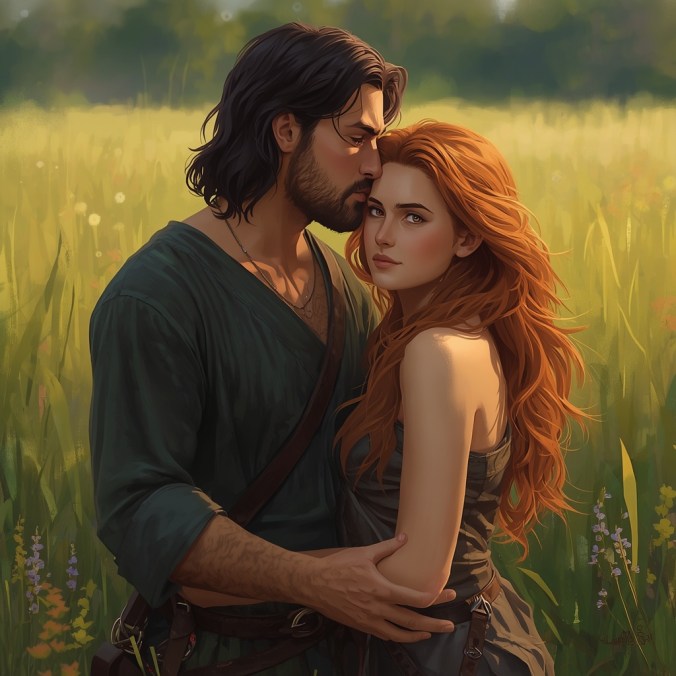
He kissed her.
It was quiet. Unhurried. The kiss of two people who had arrived somewhere after a long time of moving toward it, without urgency, without the quality of taking something before it could be lost. His hand at her jaw — Astrid’s jaw — with the same gentleness she had watched him bring to everything he did with his hands, careful and precise and entirely without performance.
She felt what Astrid felt.
That was the part she would not be able to put down cleanly when the morning came — not the kiss itself, not the specific physical fact of it, but what lived underneath it. What saturated the memory the way warmth saturates stone on a summer afternoon, present in every layer, not just the surface.
It was vast.
That was the only word that fit. Whatever Gall had felt for Astrid had the quality of something vast and carefully tended — not the consuming urgency of feeling that burned bright and brief, but something that had been held over a long time with the patient attention of someone who understood that the things worth keeping required keeping. She felt the specific weight of being known by it. Not observed, not desired in the way of surfaces, but known — the full particular specific shape of who Astrid was, held without flinching, chosen without reservation.
She felt it as her own.
The boundary between Astrid’s experience and hers had dissolved so completely that she could not have said, in that moment, where one ended and the other began. She was Aurea who was Astrid who was being kissed in a summer field by a man who was centuries from becoming the armored careful creature she had met across a worktable in Wolfbern, and the feeling was so present and so complete that it asked nothing of her — simply was, the way summer was, the way the warm stone smell was, the way the long afternoon light was.
She stayed in it longer than she should have.
That was the truth of it, examined honestly in the daylight afterward. She had the skill to surface. She had surfaced from more powerful memories than this — had pulled herself out of things that had tried to keep her with considerable force. She could have come back sooner.
She didn’t.
She stayed in the warmth of it until the memory began to thin at the edges the way all memories eventually did, the summer light losing its certainty, the grass beneath her feet becoming less specific, and then she let the thinning carry her out, and came back to the night slowly, gently, the way you surface from deep water when you’ve chosen to rise rather than been forced up.
She lay still for a long time afterward, sorting through what was hers and what was Astrid’s with the patient deliberate attention of someone doing necessary work. She thought about Alric. About Britta. About who she was and what she’d agreed to and why.
She was Aurea. Not Astrid. The warmth didn’t disappear — she knew too well how memory worked, how feeling left impressions that didn’t simply dissolve because you’d identified their origin. But it settled. Lost its urgency. Became something she could carry without being governed by it.
Eventually she slept.
In the morning she broke camp without mentioning it, and Gall did not ask, and whatever had passed between them in the night settled into the silence between them like something neither of them intended to name.
She carried it for two days.
Through the highland shelf and the mountain approaches and the conversations that kept going slightly further than the day before. Through Gall’s dry observations about the mountain pass that came from the inside of events rather than the outside, and the comment about Cazidor’s history that placed him within it rather than beyond it, and the single short laugh that surprised them both. Through the ease of it — the dangerous, undeniable ease of two people who had spent enough days together to lose the effort of it.
And on the afternoon of the second day, riding through a stretch of open highland with the mountains close now and the silence comfortable between them, she said:
“I want to say something, and I’d like you to simply listen.”
He said nothing, which she took as assent.
“I know what I’ve been feeling these past days,” she said. “I’m not going to pretend I haven’t felt it, because pretending would be an insult to both of us.” She kept her eyes on the road ahead. “I also know it isn’t entirely mine. What I caught in those fragments — Astrid’s feeling, or yours, or some mixture of both — I’ve been carrying it without knowing how to separate it from what’s my own. I think that’s where most of the confusion has come from.”
He was very still behind her.
“But I’ve sorted myself out now,” she continued quietly. “I’m not her. I look like her, and perhaps I remind you of her in ways that go beyond the looking, and I’m sorry for the pain that must cause you. Genuinely.” A pause. “But I have a husband I love and a daughter I would do anything for, and I know who I am. So I want you to know that I know — and that it changes nothing about why I’m here, or what I intend to do when we reach the Mordwahl.”
The mountains moved past them in their slow enormous way.
“I also want you to know,” she said, more softly, “that I can feel what you carry. I don’t have enough control of my ability to see it clearly, and I wouldn’t intrude even if I did. But I can feel the edges of it. The loneliness of it.” She paused. “I’m sorry for that too. It seems a very heavy thing to carry for so long.”
Gall said nothing for a long moment.
When he spoke his voice was carefully level and entirely unconvincing. “You should rest your ribs. We’ll reach the inn by nightfall.”
He felt, rather than saw, the small change in her bearing that meant she was smiling at the road ahead.
“Yes,” she said. “We should make good time.”
* * *
The village had no name worth remembering, or if it did nobody had thought to put it on a sign. It sat in the flatlands of eastern Bretagne like something the mountains had exhaled and forgotten — a scatter of stone buildings around a crossroads, a well, a paddock with three horses in it that Gall assessed automatically as they rode in. Functional. Unbeautiful. The kind of place that existed because travelers needed somewhere to stop, not because anyone had chosen it.
The inn occupied the largest building, which was not saying much. A low-ceilinged common room with a fire that meant business, four tables, a bar that doubled as the innkeeper’s command post. The man behind it was broad and unhurried and took in the sight of them — a woman held carefully in the saddle, bruising visible at her wrist, and a man whose manner suggested it would be unwise to ask unnecessary questions — with the professional neutrality of someone who had seen most things and learned to leave them alone.
“One room,” Gall said. “And I’m told there’s a healer in the village.”
The innkeeper’s gaze moved between them with the particular tact of a man recalibrating his assumptions. “My wife’s cousin. I can send for her.”
“Do that.”
The room was small and honest about it — a bed, a washstand, a single chair, a window that looked out over the paddock. Gall set their bags down and Aurea moved to the washstand without ceremony and began the practical business of cleaning three days of road off her face and hands. He watched the paddock and thought about the horses.
“There’s a bay gelding in the paddock,” he said. “Sound-looking. I’ll speak to whoever owns him in the morning.”
“Good.” She dried her hands carefully around the bruised wrist. “I’ve missed having my own horse.”
“Dusk has been tolerant.”
“Dusk has been opinionated.”
“She has opinions,” he agreed. “They’re not always wrong.”
He heard the small sound that meant she was smiling at the washstand, and looked back at the paddock.
The healer was a compact woman of middle age who arrived without fuss and examined Aurea’s ribs with the brisk efficiency of someone who had been woken at inconvenient hours before and made her peace with it. She confirmed what Gall already knew — the bones were knitting cleanly, the work done well enough — and applied a salve to the bruising that smelled aggressively of pine resin, bound Aurea’s ribs with practiced hands, and pronounced her fit to ride within reason.
When she left, the room felt smaller.
They ate at the table by the window — the innkeeper’s wife had produced something hot and reasonably good, which after days of camp provisions felt like luxury — and the fire sent warmth through the wall from the common room and the window showed them the last of the evening light fading over the flatlands to the west.
Aurea poured them both something from the jug the innkeeper had included without being asked, pushed one across the table, and settled back in the chair with the ease of someone whose ribs hurt less than they had that morning.
“Tell me something true,” she said.
He looked at her.
“You’ve listened to me talk for days,” she said. “About Britta, about Cazidor, about Alric. I’ve sorted through half my interior life out loud with you as witness.” The blue eyes were warm and direct. “Tell me something true about yourself. Something small, if you like. I’m not asking for a confession.”
He looked at the cup in his hands. Outside the window, the flatlands darkened toward night.
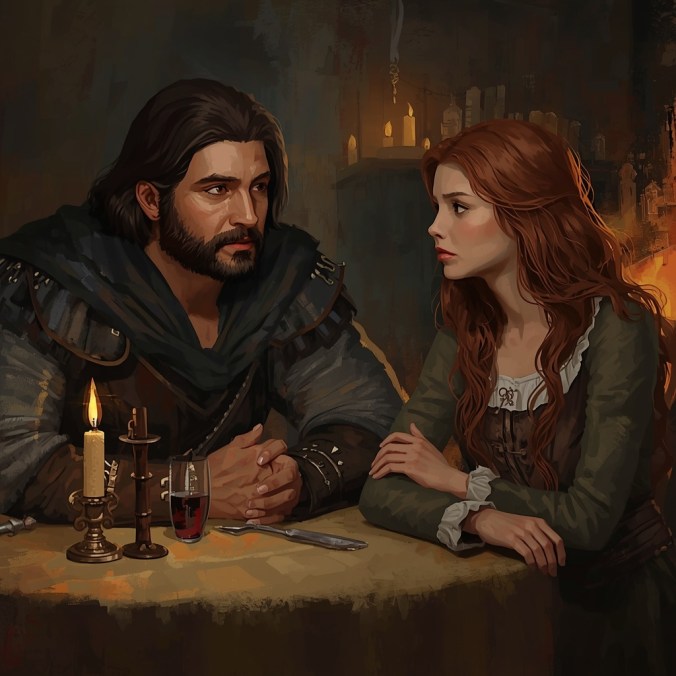
“I grew up in Tenoach,” he said.
She waited.
“It was a small city then, though it has grown since — I haven’t been back in a very long time. It was full of inns like this one, or worse. Places where you watched the door and kept your back to the wall and learned early that comfort was something other people had.” He turned the cup slowly. “I was a stone cutter. Thanks to my mother. I never knew my father.”
Aurea said nothing, listening with the quality of attention she brought to everything that mattered.
“I was good at it,” he said, and something in his voice surprised even him — a plainness, an absence of irony. “There’s something honest about stone. It doesn’t pretend. You learn to read it — where the grain runs, where the weakness is, where it wants to split and where it will hold. You work with what it is rather than what you’d like it to be.” He paused. “I preferred the open cuts to the quarry. The sky overhead. The quiet of early mornings before the other cutters arrived.”
“What happened?”
“I threw it away.” He said without drama, the way you state a fact you’ve had a long time to come to terms with. “A man hurt my mother, and I decided revenge was worth more than the life I had.” A pause. “It wasn’t. But the decision was made, and the consequences have been considerable.”
“That’s what the Caretakers hold over you,” she said quietly. Not unkindly. “Not just obligation. Penance.”
He said nothing, which was answer enough.
“And the stone cutting,” she said after a moment. “Do you still —”
“When I can.” He looked at his hands, briefly. “It’s the one thing that hasn’t changed. Stone is still stone. The grain still runs the same way. The work is the same work.” A pause. “Most things don’t last. I’ve learned not to expect it. The places I knew are unrecognizable now — the cities rebuilt over themselves, the roads rerouted, the very hills reshaped by time and weather. I’ve ridden through villages that were forests when I knew them and forests that were villages.” He turned the cup again. “It becomes — disorienting. After long enough. To be the only fixed point in a landscape that keeps changing.”
“That sounds extraordinarily lonely,” Aurea said.
“Yes,” he said simply.
Aurea was quiet for a moment, turning her cup slowly in her hands. Then, carefully — the way she asked most things that mattered — she said: “Will you tell me what happened with her? Astrid?”
He had known the question was coming since the road. He had perhaps known it was coming since Wolfbern, since the moment she’d looked up from her worktable and stopped him cold. He looked at the window and the dark flatlands beyond it rather than at her.
“I left her,” he said.
“Why?”
“Because I could see how it ended.” He turned the cup again, slow and deliberate, a man giving his hands something to do while his voice did harder work. “Not specifically. I don’t have Alric’s gift. But I didn’t need foresight to know its shape. She would grow old. I would not. She would grow ill, or simply tired, the way mortal lives do, and I would sit beside her and watch it happen, year by year, and there would be nothing I could do about any of it except stay and witness.”
“So you left instead.”
“I left instead.” He said it without flinching, which cost him something she could see plainly. “I told myself it was a kindness. That she deserved a life with someone who could grow old beside her, rather than someone who would simply watch her do it alone. I’m not entirely certain that was true. I think some of it — perhaps a great deal of it — was that I could not bear to watch. Not for her sake. For mine.”
The fire popped softly in the next room. He looked at the window and continued.
“I told myself I was sparing her the worse grief — losing me to nothing, to time simply continuing past the point where it should have stopped including me. I told myself I was sparing myself the harder one. Watching her die by inches, helpless, present for every part of it.” He finally looked at her. “I never found out if I was right. I left before either grief could prove itself. I have wondered, across a great many years, which one would have actually been worse.”
“You ran from one kind of pain,” she said quietly, “and never found out if it was worse than the kind you were certain would come.”
“Yes.”
“That seems its own kind of grief. Not knowing.”
“It is,” he said. “I’ve had a long time to understand that, and no way to do anything about it.”
The fire sent its warmth through the wall. The flatlands outside were fully dark now, the window giving back their reflections against the night. The silence between them had the quality of something completed rather than something avoided.
“Thank you,” she said finally. “For the something true.”
“It was several somethings.”
“Yes.” The corner of her mouth moved. “I noticed.”
He looked at the window and the darkness beyond it and felt, with the peculiar clarity of someone not accustomed to the sensation, that he was glad to be sitting where he was. Which was information he had absolutely no use for, and he filed it accordingly.
The sleeping arrangement resolved itself with the same wordless practicality that had governed everything since the first night. The bed was narrow but adequate. Aurea took it without discussion and was asleep with the efficiency of someone whose body was still doing the serious work of healing. Gall took the chair, which suited him — he didn’t need the bed, and the chair faced the door, and old habits died hard and slowly if at all.
He sat in the dark and listened to the village settle into night and did not think about stone cutting or Tenoach or the particular quality of early mornings before anyone else arrived.
He was largely unsuccessful, but he made the attempt, and in the morning they found the bay gelding’s owner, struck a fair price, and rode out of the village with two horses again, the distance between them restored to something appropriate.
It felt, inexplicably, like a loss.


Pingback: Astrid’s Reflection: Astrid (A Westfal Story) | Greg C. Miller, Author
Pingback: Astrid’s Reflection: Compassus Memoriae (A Westfal Story) | Greg C. Miller, Author