He felt the Mordwahl before he saw the tower.
It began as a faint wrongness at the edges of his awareness — his magic responding to the suppression the way a hand responds to cold, a slow withdrawal, a pulling inward. He had felt it before, years ago, when the Mordwahl was whole and the sensation had been merely unpleasant. Now, with the barrier near collapse, it was different — not weaker exactly, but unstable, irregular, like pressure from a wound that had already opened.
He said nothing to Aurea. There was nothing useful to say.
The tower appeared on the horizon an hour before sunset — a dark finger against the pale sky, rising from a landscape that had been subtly wrong for the past several miles without announcing why. The trees here were straggly and silent in a way that had nothing to do with the wind, the birds absent, the undergrowth still. The land around the Mordwahl had always kept its own counsel.
Aurea saw it and said nothing for a long moment.
“The Tower of Logres,” she said finally.
“Yes.”
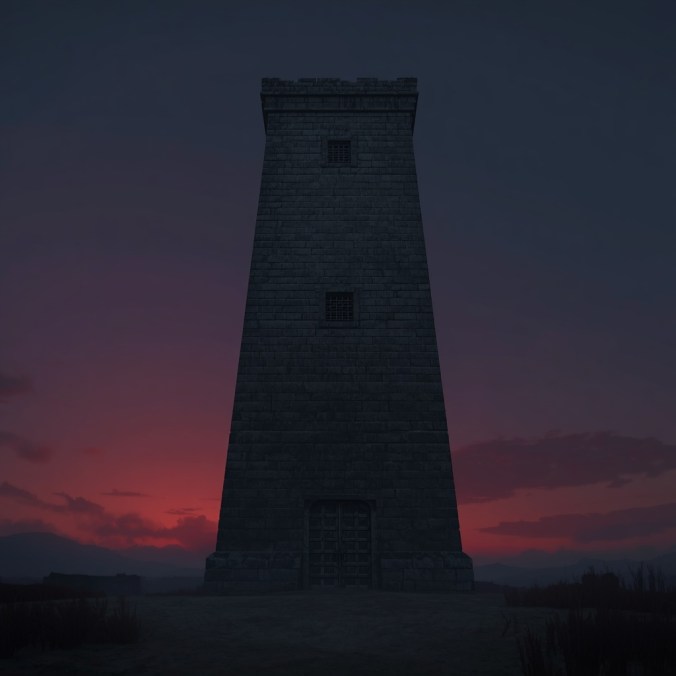
“It looks older than the legends make it sound.”
“It is older than the legends make it sound.”
She looked at it with the steady assessment she brought to difficult things, and he watched her absorb it without flinching, and they rode on.
The pin pricks began for him half a mile out — a sensation like riding into a fine invisible rain, except the rain was directed specifically at the parts of him that were not ordinary. His magic contracted further, pulling tight against itself in protest. He kept his face neutral and his hands easy on the reins and ignored it with the practice of long experience.
“You’re feeling something,” Aurea said.
He glanced at her.
“Your jaw does a thing,” she said, without particular emphasis. “When you’re managing something you don’t intend to show.”
He looked back at the tower. “The Mordwahl suppresses magic. Those with ability feel it as discomfort. The closer we get, the more pronounced it will be.”
“Will I feel it?”
“Possibly. Your ability is well-developed and native, so you may register it more strongly than I’d like.” A pause. “Or it may not affect you the same way. I don’t know exactly how the suppression interacts with your specific ability.”
She nodded, accepting this as she accepted most things — completely, without wasted energy on what couldn’t be changed.
They reached the tower as the sun touched the western horizon, the last light turning the old stones the color of old blood. Up close it was larger than it had appeared from a distance, its base broad and settled into the earth with the permanence of something that had been there long enough to become part of the landscape rather than an addition to it. No windows in the lower stories. A single door, iron-banded, standing open with the permanent open quality of a door that had not been closed in a very long time.
They dismounted and tethered the horses at a distance. Far enough that the Mordwahl’s influence wouldn’t unsettle them, close enough to reach quickly if needed.
Aurea stood looking at the open door, her hands quiet at her sides. He could see the anxiety in her — not because she showed it, but because he had spent enough days learning her tells to read what she kept controlled. The slight elevation of her chin. The deliberate evenness of her breathing.
“We should eat before we go in,” he said.
She looked at him.
“It will be cold underground,” he said. “And the work will take something out of you. Better to go in with something in you than nothing.”
She didn’t call it what it was, simply nodded and moved to the saddlebags with the economy of someone who understood that grace sometimes looked like practicality.
They sat with their backs against the tower’s base, facing west, eating in the last of the light. The horses cropped grass at the edge of their tethers. The landscape was very quiet.
“Tell me what it will be like,” Aurea said. “This memory-walk. What should I expect?”
She had drawn the compassus memoriae from her collar as she sat, holding it loosely in her hands the way he’d noticed she did when she was settling her focus — not using it yet, simply holding it. The gold caught the last of the light.
He told her. The Mordwahl’s cave would anchor them — the place where Faline had been contained, the place she had left. Her escape three months prior would have left a memory thread clinging to the stone and the mist, faint but traceable, the emotional and magical residue of a significant event fading slowly the way heat fades from stone. Aurea would find the thread and follow it — not reliving the escape itself but moving along the trail of Faline’s subsequent passage through the world, building a picture from fragments. He would be with her throughout, anchoring her to the present, watching for anything that suggested Faline was becoming aware of them.
“If she becomes aware,” Aurea said. “What does that feel like?”
“A change in the quality of the memory — something that starts to push back rather than simply unfold.” He paused. “If you feel anything like that, you pull back immediately. Don’t wait. Don’t try to take more. You pull back and I’ll do the rest.”
“And if I can’t pull back quickly enough?”
He held her gaze. “That won’t happen.”
She looked at him with the expression that meant she knew he couldn’t promise that and appreciated that he had anyway. “All right,” she said quietly.
The sun finished setting. The first stars appeared over the mountains to the east.
“Gall.” Her voice was different — not the composed queen, not the practical traveling companion. Something more private. “Whatever happens tomorrow, I want you to know that I don’t regret the decision. I made it clearly, and I’d make it again.” A pause. “I made it for Britta. But I also made it because it was right. And because —” She stopped, and he thought she might leave it there, but she continued, quietly: “Because you needed someone to say yes. And I think you don’t have enough of that. People saying yes to you rather than because of you.”
The night settled around them, cool and immense.
He had no answer for that. He sat with it instead, the way you sit with something true that you have no defense against, and after a long moment he said:
“We should get some sleep. You should, at least.”
“I know.” She didn’t move immediately. “Gall.”
“Yes.”
“Thank you. For telling me about the stone cutting.” She rose and began gathering their things with her usual efficiency, her back to him. “It helped me understand you. I think that mattered.”
He looked at the stars over the mountains and said nothing, and after a moment followed her inside to find what shelter the tower’s ground floor offered, and sat watch through the last night before the Mordwahl while she slept, and did not let his mind go where it wanted to go, and was as always largely unsuccessful.
In the morning they would descend the stairs.
* * *
The stairs descended into cold.
Not the ordinary cold of underground places — stone and darkness and the absence of sun — but something older and more specific, a cold that had intent behind it. Gall felt the Mordwahl’s presence intensify with each step, the pin pricks sharpening into something more persistent, his magic pulling tight against itself in protest. The sensation pulsed now, irregular and insistent, pressing against his skin with a rhythm that matched nothing natural. Beside him Aurea descended without complaint, one hand trailing the wall, her breathing steady.
“You feel it,” she said. Not a question.
“Yes.”
“What does it feel like?”
He considered. “Like standing in a river that’s pushing against you. Except the river is pushing against something inside you rather than against your skin.”
She absorbed this. “I feel something. A pressure. More than faint.”
“Your ability registering the suppression.” He glanced at her. “It will be stronger once we begin.”
The stairs ended.
The cave opened before them — low-ceilinged and wide, the stone walls slick with moisture that caught no light because there was no light to catch, until Gall produced a small flame in his palm that pushed the darkness back enough to see by. The effort cost him more than it should have, the Mordwahl’s suppression making the simple task sluggish and imprecise.
And there was the mist.
The mist stretched across the far end of the cave like a curtain — silent, green, faintly luminous in the darkness. Beautiful in the way of things that could kill you. The mist pulsed with a slow irregular rhythm that matched nothing natural, and the anti-magical aroma it produced was thick down here, something between iron and rain and the particular smell of a fire being smothered. Gall’s skin registered it as a thousand fine needles pressing inward, constant and specific.
Aurea stood very still and looked at it.
“She was in there,” she said quietly. “For seven hundred years.”
“Yes.”
“And now she isn’t.”
“No.”
She looked at it for a moment longer, then turned away from it with the deliberateness of someone setting something down, and looked at him.
“Tell me where to sit.”
* * *
They sat facing each other on the cave floor, close enough that their knees nearly touched, the mist at Aurea’s back and the stairs at Gall’s. She drew the compassus memoriae from beneath her collar — a small golden pendant, round and worn smooth with use, catching the light of his flame with a warmth that seemed out of place in this cold — and held it in both hands with the particular focus of someone settling into work they knew how to do.
“Give me your hands,” she said.
He did. Her hands were cold. He said nothing about it.
“I’ll find the thread first,” she said. “It may take a moment. The mist will have absorbed some of it.” Her eyes were already losing their focus, turning inward. “Don’t let go.”
“I won’t.”
She closed her eyes.
The compassus memoriae began to glow — faintly at first, then with a steady golden warmth that pushed back the cold around them. He felt her ability move through their joined hands like a current, reaching toward the mist and the memory it held. The Mordwahl pushed back — he felt that too, the suppression pressing against her power — but she held steady, her breathing even, her hands firm in his.
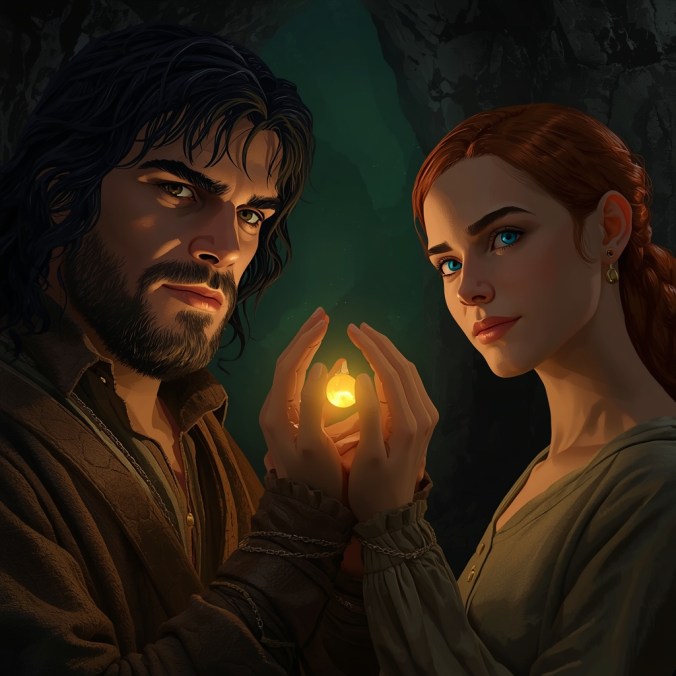
Then she found it.
He felt the moment she did — a shift in the current, something catching like a hook finding purchase — and then the cave dissolved.
The memory came in sideways, the way they always did — not a gradual reveal but an arrival, sudden and complete.
They were in the cave still, but the cave as it had been three months ago — and Faline was there.
She did not walk out.
That was the first thing Gall registered — the thing that was wrong with how he had remembered it, how he had always imagined it across the years since the Mordwahl was built. He had expected something controlled. Something worthy of Faline’s particular brand of patience and precision.
What he watched instead was a woman clawing her way through.
Her hands found the boundary of the mist before the rest of her did — plunging into it, pulling at it, the green luminescence distorting around her fingers as she dragged the barrier apart by sheer force of will. The mist resisted. He could see it resisting, the fabric of the Mordwahl pulling back against her like something alive, something that knew what it was holding and did not want to release it. She pulled harder. Her breathing was ragged in the silence of the memory, desperate in a way he had never heard from her in all the years he had known her, and something about that sound settled cold in his chest.
She had been in there a very long time.
She came through not gracefully but headlong, stumbling forward into the cave, dropping to her hands and knees on the stone floor. Dust rose around her. For a moment she simply knelt there, chest heaving, eyes squeezed shut against even the faint light of the cave. Then slowly, with the particular deliberateness of someone reclaiming themselves piece by piece, she opened her eyes.
He watched her take in the cave. The stairs. The columns. The skeleton at the base of the nearest one, the crown still on its skull.
Watched something shift in her expression that he recognized — not relief, not triumph, but something colder and more patient than either. Purpose returned after centuries of having nowhere to put it.
She rose. Crossed to the skeleton. Lifted the crown.
She held it in both hands and looked at it for a long moment — the expression on her face something Gall had no desire to examine closely — and then she placed it carefully, deliberately, on her own head. A wide, malicious grin crossed her features. A sudden kick sent the skull skittering off into the darkness. “Long live Faline, the High Queen of Westfal.”
Beside him in the memory, Aurea’s hands tightened on his.
The compassus memoriae moved them forward.
Weeks compressed into moments — Faline leaving the cave, ascending the stairs, emerging into daylight that made her close her eyes briefly against the brightness of a world she hadn’t seen in seven centuries. Her Shatain slipped out of the Mordwahl, dark-cloaked figures full of menace, following her like shadows. She looked north and began to walk, and the compassus memoriae carried Aurea and Gall after her like leaves in a current, forward through the weeks, following the trail of her passage through the world.
Faline was hungry. That was the first impression — not for food, but for everything. She consumed the world around her with her eyes, her attention, her magic reaching out to taste what had changed and what hadn’t. Seven centuries had not diminished her. If anything they had concentrated her, burned away whatever had not been essential, left something refined and very cold.
They followed her north through Bretagne, keeping what felt like a safe distance — the time gap between the memory and the present their protection, the age of the thread their reassurance. She couldn’t see them. They were watching events already past. The logic was sound.
The logic held.
For a while.
Drachnor arrived in the memory the way the country arrived in reality — abruptly, the mountains giving way to a harsher landscape, the architecture changing, the faces in the streets carrying a different quality. Faline moved through it without pause, shedding the identity of a traveler and acquiring something else — a carefully constructed persona, warmth worn like a garment over the cold underneath, charm deployed with the precision of someone who understood that power came in many forms and was not always seized directly.
The compassus memoriae slowed.
They watched her work.
Lesser nobles first — men and women with ambition exceeding their position, susceptible to the particular attention of someone who seemed to see exactly what they wanted to be seen as. She was patient with them in a way Gall recognized as predatory patience — giving enough to create obligation, withholding enough to maintain hunger. Within weeks she had a network of minor loyalties spreading through the court like roots through soil.
Then the King.
He was older than Gall had expected — a heavyset man in his late years, cautious and proud, not easily charmed. Faline didn’t try to charm him. She brought him something instead: information about a rival noble, precisely accurate, delivered with the modesty of someone who sought nothing in return. Then again. And again. Building trust with the slow deliberateness of someone laying foundations rather than raising walls.
And then, when the foundation was deep enough, she reached into his mind and locked it.
The mind-lock happened between one breath and the next. One moment the King was speaking, and the next his eyes went flat and distant, and Faline’s expression shifted into something that had nothing to do with the warmth she’d been wearing. Aurea’s hands tightened on his again.
The thread grew difficult.
He felt it before Aurea did — the quality of the memory changing beneath them, less fixed, more alive, the edges of it fraying where recent time had not yet fully settled into the past. They were walking on newer ground, and newer ground had less purchase. His skin prickled with something beyond the Mordwahl’s suppression. Something aware.
Fragments came in pieces now rather than sequence. Snatches of conversation bleeding through — armies, provisions, supply lines. Maps unrolled across tables, fingers tracing routes through mountain passes he recognized. The Black Shadow mountains. Bretagne on the other side.
He felt Aurea’s hands tighten on his. She had seen it too.
Faline seemed to flicker.
Flickered was the only word for it — a quality of instability, moments where her image in the memory stuttered, where her attention seemed to cast outward rather than remaining fixed on what she was doing. The first time, Gall pulled back instinctively, and felt Aurea resist the pull — her hands firm in his, her grip steady, not following him back. He held. The second time he pulled back again, more deliberately, and again felt her hold. Not panic. Intention. She had found something and was not ready to release it.
The third time Faline’s gaze swept the space they occupied, it lingered.
Gall leaned toward Aurea — not movement, not in the memory, but pressure through their joined hands, a signal she could not mistake. Enough. We pull back. He felt her answer in the quality of her grip — not refusal exactly, but resistance, the resistance of someone who could see the shore and was not yet willing to turn around. Her breathing had changed. Shallow. Concentrated.
He should have pulled harder. He knew this even in the moment, and did not act on it, and the not acting was its own kind of decision.
They were so close.
The King’s council chamber came into focus around them.
The King sat at the head of the table with his flat empty eyes, and his advisors arranged themselves on either side, and Faline stood at the far end with the crown on her head — Kerigahn’s crown, worn openly now, the pretense of modesty long since discarded — and she was speaking, and they were finally going to hear it, the plan laid out entire, the thing she’d spent three months building toward —
Faline stopped speaking.
In the middle of a sentence, between one word and the next, she stopped.
And turned.
She looked directly at them across the chamber with eyes fully present and fully aware, and smiled with the patience of someone who had been waiting for exactly this moment for quite some time.
“There you are,” she said.
* * *
Everything happened at once.
The Shatain materialized from the edges of the memory — a dozen of them, Mordblades drawn, forming a ring that had no gaps. The council chamber dissolved into something less specific, less anchored in place, a space that was Faline’s now rather than memory’s. She had been aware of them long enough to prepare this. Long enough to let them come all the way to the edge of what they sought before she closed the hand.
Her attention moved from Gall to Aurea with the unhurried assessment of someone taking inventory.
“The Queen of Cazidor,” she said. The smile didn’t change. “Alric’s wife. How interesting that he sent you.” Her eyes moved back to Gall. “Or did he? No — you wouldn’t have told him what you were doing. You never tell anyone what you’re doing.” The smile sharpened. “Hello, Gall. You look exactly the same. You always look exactly the same.”
He said nothing. He was already calculating — distances, the Shatain positions, Aurea’s hand in his, the compassus memoriae between them, the connection back to the cave — and finding nothing workable. The Mordblades were steady. The ring was complete.
Faline crossed the space between herself and Aurea in three unhurried steps and closed her hand around Aurea’s throat.
Not tight enough to prevent breathing. Just enough to make the point.
“Here is what I’m going to offer,” Faline said, conversationally, her eyes on Gall. “Her, for you. Walk into my hands — willingly, completely — and I’ll let her go back to her husband and her daughter and her small comfortable life.” A pause. “You have my word.”
The Shatain held their positions. The Mordblades didn’t waver.
Gall looked at Aurea.
She was looking back at him. Not at Faline. Not at the blades. At him, with the steady blue eyes that were not Astrid’s eyes, that only looked like them, and would never look like anything again if he didn’t —
“I agree,” he said.
He felt rather than saw Faline’s satisfaction — the slight easing of her posture, the sense of a long-held thing finally arriving. She had waited seven centuries for a great many things. This had been one of them.
He took a step forward.
Aurea’s hand tightened on his.
He looked at her.
She was still looking at him — only at him — and something in her expression had resolved into a clarity that he recognized too late for what it was. Not fear. Not resignation. The particular calm of someone who has already made their decision and is at peace with it.
She let go of his hand.
She mouthed one word.
Goodbye.
And broke the connection.
 Greg C. Miller, Author
Pingback: Astrid’s Reflection: The Stone Cutter’s Truth (A Westfal Story) | Greg C. Miller, Author
Pingback: Astrid’s Reflection: Goodbye (A Westfal Story) | Greg C. Miller, Author