The cave came back like a door slammed open.
He was on the cave floor, the Mordwahl pulsing green at his back, the cold stone beneath his hands, the flame he’d made guttering in the displacement of his sudden return. The transition was violent — memory to present without transition, Faline’s council chamber to this cave in a single lurching instant — and he caught himself with both hands on the floor and looked up.
Aurea sat exactly where she had been. Across from him. Inches away. Her hands in her lap, the compassus memoriae held between her palms, the golden glow of it already fading.
Her eyes were open.
“Aurea —”
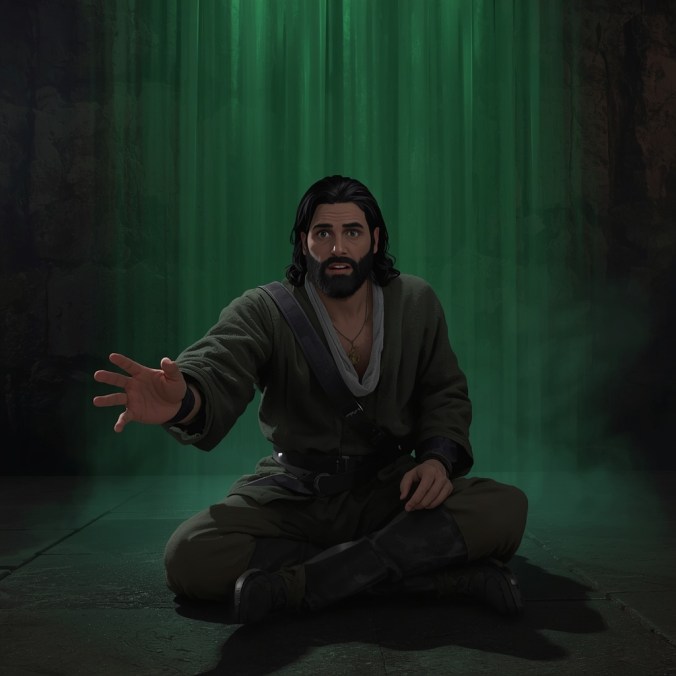
He reached for her and understood before he touched her that he was already too late. The stillness was wrong. The particular quality of the air around her was wrong — he knew that quality, had seen it before, more than once, in the years before he understood what he was serving. She was present and she was absent simultaneously, and then she was only absent, and the compassus memoriae slipped from her hands and rang once against the stone floor and was still.
He caught it before it stopped moving.
He sat on the cold floor of the cave beneath the Tower of Logres with the compassus memoriae in his hand and Aurea’s body inches away and the Mordwahl pulsing its green light behind him, and he did not move for a very long time.
Faline had taken everything. He knew exactly what that meant. Had seen it done before, more than once, in the years before he understood what he was serving. Before turning on her when given the chance. Had watched the air around the person change in that specific way, the particular quality of absence arriving before the body even stilled. Her soul. Her memories. The particular constellation of experience and hope and love that had been specifically and only Aurea. Britta’s voice saying Mama in the dark. The hunting trip with Alric where everything went wrong and somehow became a favorite memory. The mountains she’d wanted her daughter to climb someday.
Gone. Not dead in the ordinary sense. Consumed.
He sat in the cold and held the compassus memoriae and felt, beneath the grief and the guilt and the knowledge of what came next, the specific and unbearable weight of having watched her mouth the word and been unable to do anything but watch.
She had made sure of it.
Right up to the last moment, she had made sure.
He sat with the compassus memoriae closed in his fist and understood, with a clarity that arrived late and far too completely, what he had actually done all those centuries ago.
He had left Astrid to spare himself the agony of watching her die. He had told himself it was mercy — for her, for him, for both of them. Walked away before either of them had to find out whether the walking away was worse than the staying would have been.
Across all the years since, he had deferred the question. That somewhere in the vast unspooling future he might still discover the answer, in some safer context, where the decision to leave wouldn’t cost him anything irreplaceable.
But that was a lie. The cost was unavoidable.
He was watching her die now. Inches away, helpless, present for every part of it. The exact thing he had built his entire departure around avoiding — except it was not Astrid’s face going still in front of him. It was her great-granddaughter’s. The cost had simply waited. Compounded. Found a different door to come through, centuries later, with a crown of red hair and the same blue eyes and a goodbye mouthed across a space he could not cross.
He had spent centuries congratulating himself, in whatever quiet manner immortals congratulate themselves, on having avoided the worst grief available to him.
He had not avoided it.
He had only postponed it, and let it grow, and handed the bill to someone who had never asked for it and had no idea she was paying his debt when she died.
He did not allow himself to feel anything until she was taken care of.
That was the discipline of it — the one useful thing centuries had taught him. There was an order to grief, and the order began with what needed doing before anything else could happen. Feeling came later, or it didn’t come at all, and either way it waited.
He closed her eyes first.
Then he retrieved the compassus memoriae from where it had fallen and held it for a moment. The gold still faintly warm from her hands, or perhaps that was his imagination, perhaps it was already as cold as the cave — and placed it carefully inside his coat, against his chest.
The spell to preserve her body was old, older than most of the people who still used magic, learned in a context he had spent considerable effort not thinking about for several centuries. The spell did what it needed to do. Kept the body as it was, as she was, the warmth of her not yet entirely gone and he worked it with the focused attention of someone who needed to be doing something with his hands or he would stop moving entirely.
Then he took his cloak and wrapped her with the care of someone who understood that this was the last thing he could do for her and intended to do it properly. He was not gentle with himself during this. He did not deserve gentleness. But he was gentle with her, because she did.
When it was done he sat back on his heels and looked at what he’d done, and the cave was very cold and very quiet, and the Mordwahl pulsed its green light behind him with the indifferent rhythm it had maintained for seven centuries and would maintain for however long it took him to rebuild it, and he thought:
She mouthed goodbye.
She had already decided.
She was already saying goodbye while Faline’s hand was at her throat and the Shatain held their blades steady and I was taking a step forward thinking I was going to fix it.
He picked up the compassus memoriae again, briefly, and then put it away and stood and gathered what needed gathering and carried her up the stairs and out of the cave into a daylight that had no business being as ordinary as it was.
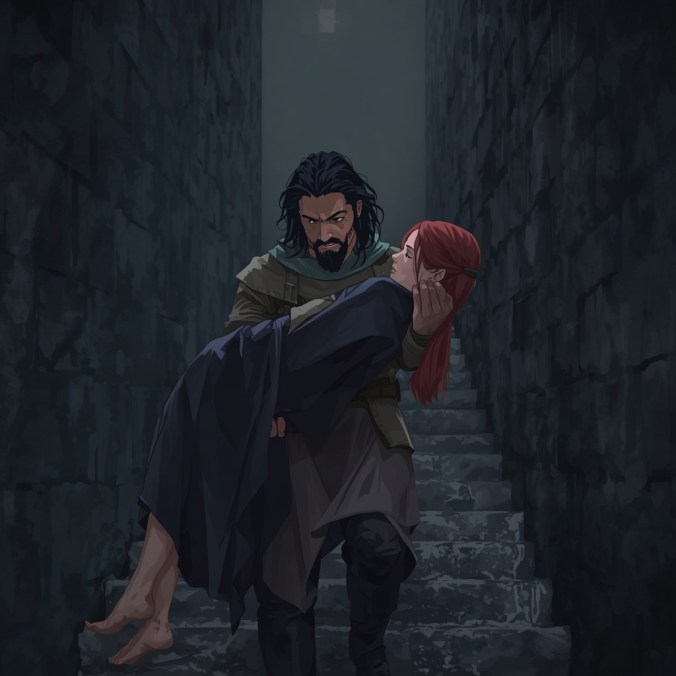
The horses knew.
Dusk knew first — raised her head when he emerged from the tower and went very still, her dark eyes tracking him across the yard with an attention that had nothing of her usual editorial quality in it. She let him secure Aurea’s wrapped form across the bay gelding’s back without argument, which was not like her, and when he mounted she moved out without being asked, steady and purposeful, as though she understood that what was needed now was forward motion and she intended to provide it.
The bay gelding carried his burden without complaint.
Gall rode.
He did not think. Thinking led places he could not afford to go, not yet, not on a road with horses to manage and a destination that required him to arrive intact. He rode instead, and the landscape moved past in reverse, and the compassus memoriae sat against his chest, and the cloak-wrapped form of the Queen of Cazidor lay across the gelding’s back, and he did not allow himself to feel anything because if he started he was not certain he would be able to stop.
There was still something that needed doing at the end of this road.
* * *
Wolfbern appeared on the horizon in the late afternoon of the third day — the city first, then the palace rising above it, the square functional towers catching the last of the light. He had looked at those towers three weeks ago and thought of the task ahead. He looked at them now and thought of nothing at all.
The road into the city was busy with the ordinary traffic of late afternoon — merchants closing up, workers heading home, children running errands with the particular urgency of children who know supper is coming. He moved through it without registering it, the horses making a path that people stepped aside for without quite knowing why, something in his bearing or his expression or simply the quality of his stillness communicating that this was not a man to be delayed.
The palace gates stood open.
Alric was there.
He was standing just inside the gate with the stillness of a man who had been standing there for some time — not pacing, not moving, simply standing with his fists at his sides and his face as closed and hard as Gall had ever seen a human face. He was not wearing his crown. He had come to the gate as a man, not a king, and the distinction was its own kind of statement.
Gall brought the horses to a stop.
For a moment neither of them spoke. The ordinary sounds of the city continued behind him — the traffic, the voices, the particular rhythm of a place that didn’t know yet what had come back through its gates.
Alric’s eyes moved from Gall to the gelding’s burden and stayed there.
His jaw tightened. A muscle worked in his cheek. His fists, already clenched, closed further, and then with visible effort released, finger by finger, the way a man releases something he has been holding so long the letting go takes concentration.
He had known. Gall could see that plainly — the knowledge sitting in him not as surprise but as confirmation, the specific agony of a man whose foresight had shown him a possibility he had spent weeks hoping would not become a reality. Knowing had not helped. It never did. The thing you saw coming hit you the same way when it arrived, and sometimes harder, because you’d had time to imagine it.
Gall dismounted.
He did not offer an explanation or an excuse. There was nothing worth offering. He simply stood in front of the man whose wife he had brought home dead and met his eyes and waited for whatever came next.
What came next was silence.
A long silence, the kind that has weight and texture, that presses against the skin. Alric looked at him with stone-cold eyes that held grief and fury and the particular devastation of a man who understood too well — who had the specific curse of understanding, of seeing how the pieces had moved to produce this outcome, which was somehow worse than ignorance would have been.
He did not move immediately toward the palace doors. Instead he turned back to the gelding and stood beside it for a moment, one hand on the animal’s neck. Then, without looking at Gall, he spoke quietly to the guard captain who had materialized at his shoulder — the words too low to carry, but their effect immediate. Two guardsmen came forward, moving with the careful deliberateness of men who had been told what was coming and had prepared themselves for it. They lifted Aurea’s wrapped form from the gelding’s back with a reverence that told Gall Alric had given very specific instructions about how this was to be done.
Alric watched until she was inside the gate and out of sight. His back was to Gall throughout. Whatever crossed his face in those moments was his alone.
Then he straightened, and turned, and his expression was stone again.
“You should come inside,” he said.
His voice was level. Controlled with the effort of a man who had decided, somewhere in the hours of waiting, that he would be controlled. That he would not break in a palace gateway in front of his guards and his city.
“Yes,” Gall said.
He took the gelding’s reins and followed the King of Cazidor into the palace, and the gates closed behind them, and the city continued its ordinary afternoon without knowing that anything had changed.
The study was a working room.
Not a ceremonial space, not a room designed to impress, but a place where actual work happened. Maps on the table, weighted at the corners. Correspondence in ordered stacks. Bookshelves that had been used rather than arranged, the volumes pulled and replaced at angles that suggested consultation rather than display. A fire already burning, as though someone had lit it hours ago in preparation for a conversation they had hoped would not be necessary.
The portrait hung above the fireplace.
Alric, younger, the mercurial energy of his youth still visible in the set of his jaw, and beside him, Aurea with red hair loose and blue eyes catching the painter’s light in a way that made something clench in Gall’s chest. Between them an infant Britta, round-faced and imperious even then, regarding the world with the focused intensity of someone who had opinions about it already.
He looked at it once and then looked away and did not look at it again, or tried not to, and failed at intervals throughout what followed.
Alric poured two cups from a decanter on the table without asking and set one in front of the chair across from his own and sat down. He did not touch his cup. Gall sat and did not touch his either.
“Tell me,” Alric said.
So Gall told him.
He told it plainly and in order, without softening the parts that needed softening or hardening the parts that needed hardening. The Caretakers’ warning. Arriving in Wolfbern to find Alric gone. Aurea agreeing — freely, clearly, with full knowledge of the risk as he understood it. The ride. The Tower of Logres and the cave and the Mordwahl pulsing green in the dark. The compassus memoriae and Aurea’s hands in his and the memory thread pulling them forward through weeks of Faline’s movement until they stood at the edge of what they’d come for.
He told him about the trap. How Faline had let them come all the way to the precipice of understanding before she turned and looked directly at them across the space of the memory. How she had taken Aurea by the throat. What she had offered.
He told him that he had agreed to Faline’s terms.
He told him that Aurea had not let him follow through.
He told him about the goodbye.
He said it simply, without decoration: she looked at me and mouthed goodbye and broke the connection and expelled me from the walk before I could stop her. He said it and watched Alric receive it and did not look away, because looking away would have been a mercy he hadn’t earned.
Alric sat very still through all of it. His face had not changed from the expression he’d worn at the gate — stone-cold, controlled with visible effort. But his eyes were doing something that his face was not, and Gall, who had learned to read people across centuries of close observation, did not examine it too directly because it was not his to examine.
When Gall finished speaking, the room was quiet except for the fire.
Alric looked at his hands on the table. After a long moment, he said, “She knew what she was doing.”
“Yes.”
“She always knew what she was doing.” Something moved through his voice that didn’t make it into his expression. “Even when I wished she wouldn’t.”
Gall said nothing.
A silence stretched between them. Then Gall looked above Alric’s face rather than at it. He could not make himself meet the man’s glare directly. “I don’t know why she did what she did.”
Alric’s face snapped to his after a moment. “Yes you do. You know very well why she chose, but you’re just avoiding the conclusion.”
Gall stared at him, dumbfounded.
Alric’s look was full of fury as well as resignation. “She couldn’t let you die, for without you, Faline wins, the Mordwahl collapses, and the world as we know it ends.”
“I didn’t ask her to do this,” Gall snapped back.
“That does not matter,” Alric said. “She took the measure of the situation and made her peace with it.”
The fire settled in the grate. The silence that followed was different from the one before — not the silence of things unsaid, but the silence of something true that had been spoken and could not now be unspoken.
Gall reached into his coat and placed the compassus memoriae on the table between them. The gold caught the firelight — warm, small, worn smooth by generations of hands before Aurea’s. He slid it across the table toward Alric and withdrew his hand.
Alric looked at it for a long moment without touching it. Then he picked it up and closed his fist around it and set his hand in his lap and did not open it again.
The portrait looked down at them from above the fireplace. Gall was aware of it the way you are aware of something you are trying not to look at — completely, and in spite of yourself.
“I accept full responsibility,” Gall said. “For asking her. For allowing her to agree. For not —” He stopped. Started again. “For everything that followed from my decision to come to Wolfbern.”
Alric looked at him then. The stone-cold expression had not changed, but something behind it had shifted. Not toward forgiveness, nothing so clean as that, but toward something more complicated. Recognition, perhaps. The particular look of a man who understood too well the architecture of unavoidable outcomes.
“I know,” Alric said quietly. “I know how the pieces moved. I saw — some of it. Not all. Enough.” He paused. “That doesn’t make it easier to sit here.”
“No,” Gall said. “I don’t imagine it does.”
The fire settled in the grate. Outside the study’s window the last of the daylight was giving way to evening, the ordinary business of Wolfbern continuing its ordinary rhythms beneath a sky that had not been informed of what had changed.
Alric set both hands flat on the table. When he spoke his voice had a different quality — not the grief-controlled tone of the past hour, but something more deliberate. A king making a decision.
“Britta,” he said.
Gall waited.
“She doesn’t know yet. She’s still away.” His jaw tightened briefly and released. “I’ll tell her that her mother died. I’ll tell her — enough. What she needs to know.” He looked at Gall steadily. “What she doesn’t need to know is any of what you’ve told me tonight. Not Faline. Not the memory-walk. Not —” He stopped. “Not any of it.”
“I understand.”
“I’m not asking for your understanding.” Alric’s voice was level and very precise. “I’m asking for your word. That you will never tell my daughter what happened to her mother. Not how, not why, not what Aurea chose at the end.” A pause. “I will tell her myself. When the time is right. When she is ready.” Another pause, quieter. “If that time comes.”
Gall looked at the man across the table, at the King of Cazidor, Aurea’s husband, the father of a girl who would inherit a kingdom and climb mountains someday. And had no idea yet that her mother was gone — and said:
“You have my word.”
Alric nodded once, the motion of someone closing a door.
The silence that followed was different from the one before. Not the silence of things unsaid, but the silence of things concluded. The compassus memoriae sat in Alric’s closed fist in his lap. The portrait looked down from above the fire. The evening settled around the palace with the indifferent patience of evenings that do not know or care what has happened inside the walls they surround.
Gall sat in the study of the King of Cazidor and felt, with a clarity he had not experienced in longer than he could honestly account for, the full weight of what it was to have lived as long as he had and made the choices he’d made and arrived, again and again, at rooms like this one.
Never in centuries had he so completely cursed his own existence.
Not when the Caretakers had first laid their terms before him. Not when he had understood the full scope of what he’d done in Kerigahn’s service. Not in any of the long decades of obligation and penance and forward motion that had followed.
Here. This room. This man with his closed fist and his stone-cold face and his specific and particular grief that Gall had delivered to his door wrapped in a cloak and carried across three days of hard riding.
This was the one he would carry longest.
He knew it the way he knew most things that mattered — not as a thought but as a settled certainty, the kind that didn’t require examination because it was simply true.
He stood.
“I won’t take more of your time,” he said.
Alric didn’t stand. He looked at the fire with the expression of a man who had used up everything he had on the past hour and was now simply present in the wreckage of it, waiting for the next thing he’d need to be something for. There would be arrangements to make. Aurea to be laid properly in the family tomb. A daughter to be told. A kingdom to be run in the meanwhile, because kingdoms did not pause for grief.
“Gall,” he said, without looking up.
Gall stopped at the door.
“You said you have unfinished business elsewhere.”
“Yes.”
A long pause. “Then go.” The words were quiet and final and carried everything that wasn’t being said in the space around them. “Go and don’t come back until it’s done.”
Gall looked at the portrait one last time. Aurea young and red-haired and blue-eyed above the fire, holding infant Britta with the ease of someone entirely at home in the life she’d chosen. Then he opened the door and left the study and walked through the corridors of the palace of Wolfbern without stopping until he reached the yard and his horse and the open road beyond the gate.
Alric did not watch him go.


Pingback: Astrid’s Reflection: Compassus Memoriae (A Westfal Story) | Greg C. Miller, Author