They made good time on the first day, which suited Gall.
Movement was preferable to stillness. Stillness left room for things he had no intention of entertaining.
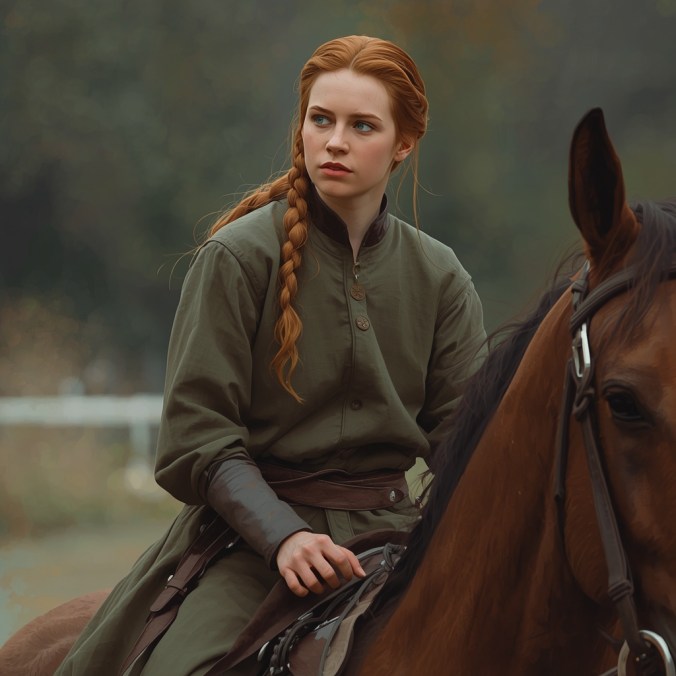
Aurea rode well — better than he had expected, though he recognized the thought as condescending the moment it formed and discarded it. She was a queen who had grown up in Cazidor, where practicality was a virtue and horsemanship was not considered an accomplishment so much as a basic competency. She kept pace without complaint and asked no unnecessary questions, which he appreciated more than he would have said.
His mare, Dusk, had taken Aurea’s measure at the outset, circling her with that particular feisty suspicion she reserved for strangers, and then apparently decided she was acceptable, which Gall considered a reasonable endorsement.
They spoke little throughout the morning. The road southeast out of Wolfbern ran through open Bretagne farmland before climbing into the lower foothills, and the landscape demanded attention enough to fill the silence naturally. Gall told himself this was fine. Professional. Appropriate.
Aurea broke the silence somewhere in the early afternoon.
“How long has it been since you’ve seen Faline?”
He considered the question. “Long enough that the world has changed considerably around her absence.”
“That isn’t an answer.”
“No,” he agreed. “It isn’t.”
She absorbed this without visible irritation. He had expected her to push. The directness she’d shown in the palace suggested someone who did not accept deflection easily, but instead she simply looked at the road ahead with a thoughtful expression, as though filing the non-answer away for later consideration. That restraint was somehow more unsettling than persistence would have been.
“Alric says you’ve been useful to the Caretakers for a very long time,” she said after a while.
“Alric is diplomatic.”
“He also says you’re difficult.”
“Alric is perceptive.”
She laughed at that — a genuine laugh, unguarded, and Gall fixed his eyes on the road ahead and said nothing. She told him about her family somewhere in the unhurried middle of the afternoon — the particular recitation people fall into on long rides, when conversation needs feeding and personal history is the easiest fuel. Her mother. Her grandmother, who had been formidable in ways the court still talked about. A great-grandmother named Astrid, whom Aurea knew almost nothing about beyond the name itself; a line in a genealogy, a portrait that had been lost in a fire two generations back, nothing more.
“I always liked that one,” Aurea said. “Astrid. There’s something solid about it. The others all sound like they were named for how they’d look in a poem.”
Gall said nothing, and kept his eyes on the road, and was grateful she couldn’t see what the name did to his face.
They camped that night in the shelter of a rocky outcropping where the foothills began, far enough from the road to be invisible to passing travelers. Gall built the fire with the efficiency of someone who had done it ten thousand times, which he had, and Aurea unpacked their provisions with the same practical ease she brought to everything.
The temperature dropped with the sun. This far north, even in the milder season, the nights had an edge to them — the mountains breathing cold air down into the foothills as darkness settled. Aurea ate and said little, and Gall watched the fire and said less, and the silence between them was not uncomfortable exactly, but it was aware of itself.
When she had finished eating, she wrapped her bedroll around her shoulders and sat close to the fire, but not close enough. He could see her trying not to shiver and not entirely succeeding.
Gall did not deliberate about it. Deliberating would have meant acknowledging the decision, and he had no interest in that. He simply moved to sit beside her, close enough that his body blocked the wind, and said nothing. She stiffened slightly — surprise, not objection — and then, after a moment, settled against him, and the shivering gradually stopped.
He kept his eyes on the fire, his mind carefully blank, and listened to her breathing slow as she drifted toward sleep.
She was warm. He was aware of this the way he was aware of things he had decided not to be aware of — completely, and in spite of himself.
The fire burned low. The mountains exhaled cold air across the foothills. Gall kept watch, did not let his mind wander, was largely unsuccessful, and was grateful that the dark covered whatever moved across his face in the small hours before dawn.
* * *
She was already awake when the sky began to lighten.
Gall knew because her breathing changed. The slow evenness of sleep gave way to something more present, but she lay still for a while in the way of someone enjoying the rare luxury of waking without obligation. He had shifted her into her bedroll sometime in the small hours, when the fire had burned to coals, and the cold had settled in earnest. He had done so carefully, but he did not examine the effort.
When she finally sat up, her red hair was loose around her shoulders and her blue eyes were clear in the early light, without the groggy confusion most people wore in the first moments of waking. She looked at him across the dead fire with the directness that was apparently simply how she looked at things.
“You moved me,” she said.
“You were going to have a stiff neck.”
“Mm.” She began gathering her hair back with the practical efficiency he was coming to recognize as characteristic. “Thank you. For that, and for the warmth.” A pause. “You didn’t sleep.”
“I don’t need to.”
She accepted this without the barrage of questions most people would have produced, simply nodding once as though filing it alongside everything else she was quietly accumulating about him. He found her restraint both easier and more difficult than curiosity would have been. Curiosity he knew how to deflect. Patience he was less certain about.
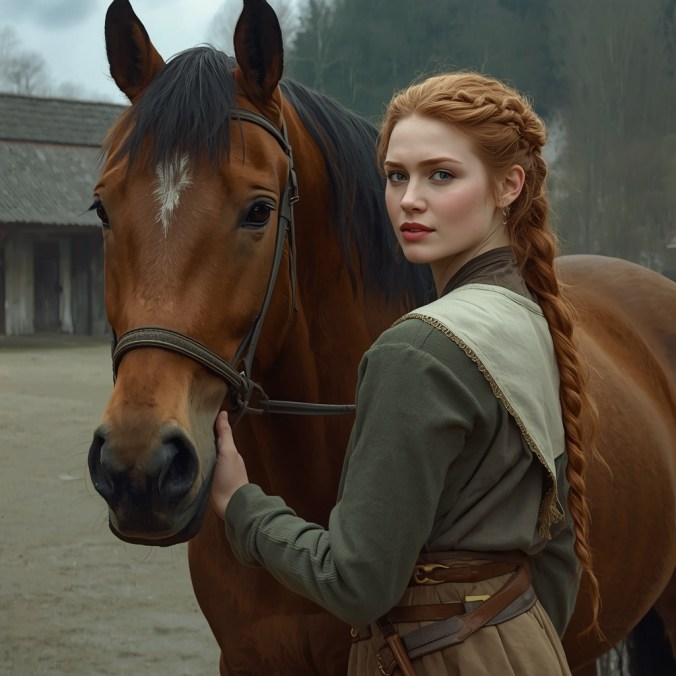
They broke camp in the comfortable silence of people who had already established a rhythm, and were on the road before the sun had fully cleared the eastern hills.
The morning passed in the easy quiet of the day before. The foothills rose around them, the road narrowing as it climbed, the farmland giving way to stands of pine and birch that smelled of resin and cold water. Dusk moved with her usual opinionated energy, occasionally expressing views about the terrain that Gall ignored with long practice.
Aurea rode slightly behind him for most of the morning. He was aware of her attention in the way he was aware of most things — peripherally, and in spite of himself.
“You knew about my memory-walking ability before you came to Wolfbern,” she said eventually. Not accusatory. Observational.
“I knew it ran in your family line.”
“How?”
He kept his eyes on the road. “It’s my business to know things. Threats, capabilities, bloodlines that carry abilities worth tracking.”
“That sounds like something you say when you don’t want to answer the question,” she said pleasantly.
He said nothing.
“You said you know my lineage,” she continued. “But when you said it in the palace it sounded less like you’d read about my family and more like —” She paused, choosing the word carefully. “More like you’d met them.”
The silence stretched a beat too long. He had felt the slip when he made it and had hoped she hadn’t caught it. He should have known better.
“Your family has produced remarkable people across several generations,” he said. “I have had occasion to encounter some of them.”
“Encounter,” she repeated. “That’s another careful word.”
“I’m a careful man.”
“You weren’t, just then.”
He looked at the road ahead and said nothing, and after a moment she let it rest — not abandoned, he suspected, but set aside. He’d watched her long enough now to read the difference.
They rode in silence for a while. The road crested a rise and the mountains came into full view ahead, blue-grey and enormous, their upper slopes still holding the last of the season’s snow. Aurea reined in without being asked and simply looked at them for a moment.
“Britta wants to climb them someday,” she said. “The mountains. She’s been talking about it since she was small.” The warmth in her voice was unguarded in a way nothing else about her had been. “She has a list. Things she wants to do that have nothing to do with being a princess. Climb the mountains. Sail to the outer islands. Learn to fight properly, not just the ceremonial version they teach court ladies.” A small laugh. “Alric encourages her. I pretend to disapprove and then encourage her when he’s not looking.”
Gall listened and said nothing.
“She’ll be a good queen,” Aurea continued, more quietly. “Better than good. But I want her to have a life that’s hers before the crown swallows everything else. Her own choices. Her own direction.” A pause. “Is that a foolish thing to hope for?”
“No,” he said. The word came out with more weight than he intended.
She glanced at him, catching something in his tone. He kept his face forward.
He was thinking of Larah. Of a young woman he had watched from a careful distance for years, hoping the same thing — that the world’s larger business would not swallow her particular life whole. Aurea knew Britta’s list. Every item on it, specific and vivid, the mountains and the outer islands and the proper fighting. She knew it the way a mother knows things, from proximity and attention and the daily accumulation of a shared life.
He did not know Larah’s list. He had made sure of that. The distance that kept her safe from what he was also kept him from knowing what she dreamed, and he had told himself across many years that this was the right arrangement, the necessary one, and he still believed that, mostly, and it sat in him this afternoon like a stone.
“She sounds like someone worth protecting,” he said finally.
Aurea looked at him for a moment — whatever she read in his face, she kept to herself. “Yes,” she said softly. “She is.”
They made camp that evening in a clearing beside a narrow stream, the mountains considerably closer now, their peaks catching the last of the light. The cold came earlier here, more decisively, and when Gall settled beside Aurea without comment or ceremony she leaned against him with the matter-of-fact ease of someone accepting a practical arrangement rather than making anything of it.
Which was sensible. Which was exactly right.
He kept his eyes on the dark tree line and his mind carefully occupied and told himself that the ease of it — the way she fit against him without awkwardness, the way the silence between them had become genuinely comfortable rather than simply managed — was irrelevant. Tactical. A function of proximity and shared purpose.
He was largely unconvinced by this argument, but he made it anyway, and the night passed, and in the morning they broke camp and rode on toward the Mordwahl.
* * *
The morning of the third day was the best they’d had.
The road had leveled into a long highland shelf between the foothills and the first true mountain slopes, the air sharp and clean, the sky an unbroken pale blue above the treeline. The pines here were older, larger, their canopy high enough to let the light through in long slanted columns that moved across the road as the morning progressed. Even Dusk seemed to have made her peace with the journey, moving with less editorial commentary than usual.
Aurea had been talking for the better part of an hour.
Not extensively — she was not a woman who filled silence for its own sake — but the previous two days had worn something down between them, and she spoke more freely now. About Cazidor. About Britta’s latest argument with her tutors. About a hunting trip she and Alric had taken three years past, in which everything that could go wrong had, methodically, and which had somehow become one of her favorite memories. She told it well, with a dry precision that made him want to smile, which he didn’t, but the wanting was there.
Gall listened, offered occasional responses, and was careful not to examine how natural this had become. Two people on a road. A conversation without agenda. He could not remember the last time he’d had one.
The snake was on a flat rock just off the road’s edge, warming itself in a shaft of morning light. In itself it was nothing — a common highland adder, thick-bodied and slow with the morning cold, entirely uninterested in horses or riders. Gall saw it and thought nothing of it.
Aurea’s mare saw it differently.
The horse shied hard to the left with no warning — a full-body flinch, violent and instantaneous — and Aurea, relaxed and mid-sentence, had no chance. She went over the right side cleanly and hit the road with a sound that Gall felt in his back teeth.
He was off Dusk before the mare had finished her panicked sidestep, crossing the distance in three strides, dropping to one knee beside her.
She was conscious. That was the first thing. Her eyes were open, blinking at the sky with the stunned expression of someone whose body had not yet fully reported in.
“Don’t move,” he said.
“I’m —”
“Don’t move yet.”
He put his hands on her carefully, reading her the way he read most things — with the particular attention of someone who understood what lay beneath surfaces. Her left arm had taken the worst of it, the wrist broken cleanly, and her ribs on the same side were cracked — two of them, possibly three. Her head had struck the road but glancingly, her shoulder taking the primary impact. Painful. Serious enough. Not, he thought, fatal.
Her mare had bolted. He heard the hoofbeats fading and did not look up.
“Your wrist is broken,” he said. “And your ribs. Hold still.”
“The horse —”
“Is gone. Hold still.”
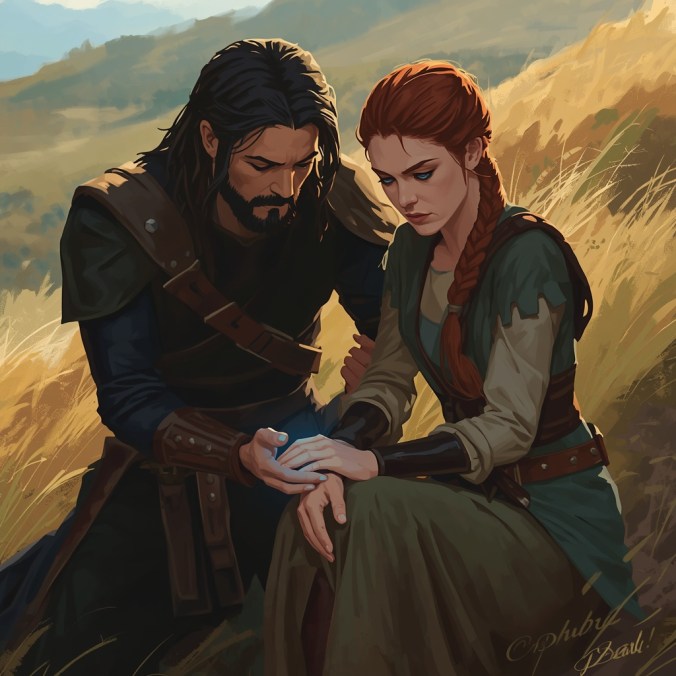
He placed his hands over her wrist, whispered “sana,” and let his magic find the break and begin the careful work of drawing it closed. The healing was slow, imperfect work — he could mend the bone but the bruising would remain, the deep tissue damage requiring days rather than hours to resolve itself fully.
He did not notice the moment her ability touched him.
He should have. He knew what she was — knew the skill of her, the precision she brought to memory-walking under ordinary circumstances. But ordinary circumstances did not include a hard fall on a mountain road with two cracked ribs and a broken wrist, and pain had a way of disrupting even the most disciplined control. Not because it weakened the ability — if anything, physical extremity could sharpen it — but because control required a quality of deliberate attention that agony had a way of commandeering.
Her ability opened like a door blown inward by the wind.
And his memory surfaced to fill the gap she had opened.
He felt it happening the same moment she was pulled in — felt the memory surface from wherever he kept it, drawn up by the proximity and the resemblance and the weeks of imperfect vigilance that had preceded this moment, and knew with cold clarity that it was too vivid, too intact, too preserved by the specific curse of his nature to be anything other than overwhelming to a memory-walker caught unprepared. He couldn’t stop it in time. He felt her go — her hands still in his but her awareness suddenly elsewhere — and there was nothing he could do but hold on and keep working and wait for her to come back.
For Aurea, the memory arrived with the completeness of something that had been waiting.
One moment she was on the road, cold stone beneath her, Gall’s hands on her wrist, the mountain air sharp in her lungs. The next she was somewhere else entirely — and the transition was not gradual, not the careful controlled entry she was accustomed to, but a full immersion, sudden and absolute, like stepping through a door she hadn’t seen coming.
A room. Stone-walled, firelit, small in the way of functional private spaces rather than grand ones. The fire was built high against serious cold, and the light it threw was warm and unsteady, and she understood within a breath that she was somewhere very old — not just the room, but the moment itself, the quality of it, the specific texture of a memory preserved far beyond what time should have allowed.
This was not a fading recollection. This was a memory kept at full intensity across centuries by a nature that did not permit the ordinary mercy of dimming.
She registered this with the part of herself that was still the skilled practitioner, still Aurea observing even inside the unexpected entry — and then the memory’s gravity pulled her deeper, and observation became experience.
Gall was there.
He was kneeling beside a low bed, his back partially to her, his hands moving over an injury with the focused attention she recognized from the road outside — the same quality of concentration, the same deliberateness, the same care. He looked different in some quality she struggled to define. Not younger exactly — the bones of his face when he turned slightly were unmistakably his — but less armored. Less constructed. As though the centuries of careful distance hadn’t yet been built, or hadn’t yet been needed.
The woman on the bed had red hair and sparkling blue eyes. “Ow, that hurts,” she said in a petulant but somewhat lighthearted tone.
“Astrid,” Gall muttered lightheartedly. “Stop being silly. I need to heal you.”
Aurea saw it before she saw anything else — the red hair spread against the pillow, the particular shade of it in the firelight — looking so much like her they could have been sisters.
Astrid lay with her eyes half-closed and her breathing shallow, one hand loose at her side, and Gall worked over her injury with the same hands he was using on Aurea’s wrist right now, in the road, in the present, and the overlap was so immediate and so complete that Aurea felt it in her chest before she felt it in her mind.
He was speaking. Too low to catch all the words, but the tone was unmistakable — the deliberate calm of someone managing their own fear through the discipline of action. She had heard that tone from him already, in the minutes after the fall, and hearing it here across what must have been centuries was its own particular strangeness.
Astrid opened her eyes fully.
Blue eyes. Looking up at Gall with an expression that Aurea felt land somewhere in herself without permission — the specific relief of someone who had been frightened and was no longer frightened because this particular person was present. Not just any help. His help. The distinction mattered and was visible in every line of Astrid’s face.
Gall looked back at her and said something, and Astrid laughed despite the pain, and the laugh was —
Aurea pulled herself out.
It took effort. The memory had the grip of something extraordinarily vivid — she felt it resist her withdrawal the way deep water resists a swimmer turning back toward the surface, the current of it strong and specific and entirely unwilling to release what it had caught. She surfaced through it with the concentrated discipline of long practice and came back to the road gasping slightly, the cold air and the stone beneath her and Gall’s hands on her wrist arriving all at once.
He was looking at her.
He knew. She could see it in the tension at the corner of his jaw, the controlled stillness of his expression — the look of a man who had felt the memory surface and understood too late what it had collided with.
“That memory,” she said, when she had her breath. “It didn’t fade. It was completely intact. Every detail.”
Something moved through his expression that he didn’t entirely manage to contain.
“How long do you keep them like that?” she asked quietly.
He looked back down at her wrist. “Long enough,” he said. “Hold still. I’m not finished.”
She held still. He finished the healing — the bruising livid beneath the skin, the bone beneath it whole — and when he finally sat back she flexed her fingers experimentally and looked at his face.
He was looking down at what his hands had done. The moment stretched.
“Astrid,” he said.
The word came out without warning, quiet and unguarded, and he understood what he’d said the same instant she did.
He stopped. The controlled blankness came down over his expression like a shutter, too late.
She looked at him steadily. She had a great-grandmother named Astrid. She had never known her, never seen a portrait, never heard more than the name attached to a genealogy entry. And she had just watched Gall tend that woman’s injury with the same careful hands that had mended her wrist, in a room that was centuries old, in a memory too vivid to be anything other than entirely real.
The name connected everything.
“Who was Astrid?” she asked quietly.
“Someone I knew,” he said. “A long time ago.”
She held his gaze for a moment, and whatever she read in his face she chose not to press. She had enough. The face in the memory. The name. The way he’d said it, and the way he’d stopped. She had enough to understand the shape of it, if not the full particulars.
“Can you stand?” he asked.
“Give me a moment.”
He gave her the moment, and then helped her up, and the mare was gone, and Dusk waited, and neither of them said anything more about Astrid. But the name sat between them for the rest of the day with the particular weight of something acknowledged without being resolved, and when he helped her into Dusk’s saddle and swung up behind her — the lost mare making the arrangement unavoidable, practical, necessary — she settled against him without awkwardness and he kept his eyes on the road ahead.
The snake was gone from its rock. The morning’s peace was gone with it.
They rode on toward the mountains.


Pingback: Astrid’s Reflection: The Bargain (A Westfal Story) | Greg C. Miller, Author
Pingback: Astrid’s Reflection: The Stone Cutter’s Truth (A Westfal Story) | Greg C. Miller, Author