Sleep wouldn’t come.
She lay on her back in the dark, listening to the wind work at the gaps in the stone walls, and thought about Alax. About the warmth of a fire surrounded by people who knew your name. About how it felt to hand someone a bowl of food and have them look at you like you belonged there.
Stop it.
Ravael’s face surfaced instead, the way it always did when she let her guard down. Blood-rimmed eyes. The terrible stillness. She squeezed her own eyes shut, but that only made it worse — the image pressed harder against the inside of her eyelids, patient and permanent.
This was her own making. She knew that. Didn’t stop it from feeling like swallowing stones.
She reached for Grandmama’s voice — half hoping, half dreading — that sharp sardonic presence that would say something cutting about weakness, about humans and their bottomless need for each other. Something to push against. But there was nothing. The silence where Grandmama had been was its own kind of cold, different from the wind coming through the walls.
The magical knowledge was still there. She could feel it the way you feel a tool sitting in your hand — present, solid, impersonal. But the woman behind it was gone or going. Fading like breath off a mirror.
She’d never felt more alone.
Eventually, the cold and the exhaustion did what her will couldn’t, and sleep took her.
* * *
Her eyes snapped open into total darkness.
Something was breathing outside.
She didn’t move. Just listened, heart already slamming. The breathing shifted — from the right side of the entrance to directly in front of it — slow and deliberate, like something that had all the time in the world.
Wolf. The thought sent a jolt of sick cold through her. The last wolf. The sounds it had made.
Her hand found the knife before she’d consciously reached for it. She pressed it to her chest and felt her own heartbeat against her knuckles.
The animal skin over the opening pushed inward.
She scrambled back on her heels, hit the stone wall, sent rocks tumbling down her spine. Dirt from the roof peppered her hair. And then a head came through — short snout, white fangs, black eyes that found hers in the dark and locked on with an intelligence that made her stomach drop.
Not a wolf.
The growl that followed came from somewhere deep in the creature’s chest. She felt it more than heard it.
Reach inward. Find the shelf. Take the tool.
“Soul-ees,” she said, palm out.
Light burst through the shelter like a breaking day. The bear flinched back with a grunt, the entrance went quiet, and the light died in her hand. Darkness again.
She sat trembling, listening to her own breathing stutter.
Then the snuffling came back. Closer. A thump hit the outside wall hard enough that she felt it in her feet. Dust rained from the ceiling. Another thump, and stones shifted.
It’s throwing itself against the walls.
She was on her feet before she finished the thought, but there was nowhere to go — the roof was already groaning, the structure shuddering with each impact. When it came down, it came down fast. Stone and dirt and a crack of pain across the side of her face that whited out everything for a moment. She was on the ground, pinned, rocks across her legs and chest, tasting blood.
Then the pressure on her leg changed. Sharpened. Became two rows of points driving through her thigh, and she heard herself scream from somewhere far away.
One more word. She had one more word.
She didn’t know what it meant — just that it was there, borrowed from a dying woman who had seen fit to give her the weapons but not always the warnings. She grabbed it the way you grab anything when you’re drowning.
“Scoot-to kaylee!“
The wind wasn’t a gust. It was a fist. The entire shelter — every stone, every stick, every scrap of bracing — went outward at once with a sound like the world cracking open. The bear made a noise she’d never heard a bear make. Then nothing. Just the roar of air and then silence rushing in to fill it.
She lay in the open, staring up at the stars.
Her ears rang. Her leg burned. Slowly, she registered the cold against her back — no walls, no roof, nothing between her and the night sky.
The knapsack was on its side near the tree. Half its contents lay scattered across the rocks. The cookpot was simply gone. So was most of the dried meat. She lay there looking at the wreckage for a long moment and couldn’t find it in herself to be surprised. Too much or not enough. That was the shape of things when she used the Old Ways. She’d known it even as she spoke the word. She’d done it anyway.
What else was I supposed to do?
It wasn’t a question.
Her leg. She ran a hand down it and found the holes — two pairs, parallel, above the knee — and the blood running warm and fast between her fingers. She needed height. She needed to not be on the ground.
She dragged herself to the tree. Three attempts to get up it before her arms found something they remembered from the first terrible nights here, and she hauled herself into the branches. She sat with her back against the trunk and her ruined leg extended and waited for her heart to slow.
Hours later, snuffling in the dark below. She watched it come and go.
Dawn found her still awake.
* * *
When the light was full enough to see by, she looked at what was left.
The shelter was rubble. Her spell had done at least as much damage as the bear. She cataloged the losses the way you press a bruise — methodically, because stopping hurts more. Cookpot: gone. Most of the dried meat: gone. The sense of having built something that was hers: also gone, which surprised her by stinging as much as the rest.
She climbed down when her leg allowed it. The throbbing went all the way up into her hip with every step, and she moved slowly, gathering what she could from around the waterhole.
North, then. She’d been telling herself north for days. The Gulf. Better odds there, maybe, or at least different odds. She’d take different.
She made herself eat first — stale bread, eaten standing, looking at the mess of her own making. While she chewed, she noticed she wasn’t asking herself whether to go. Just when.
Grandmama would have something to say about that.
But Grandmama didn’t.
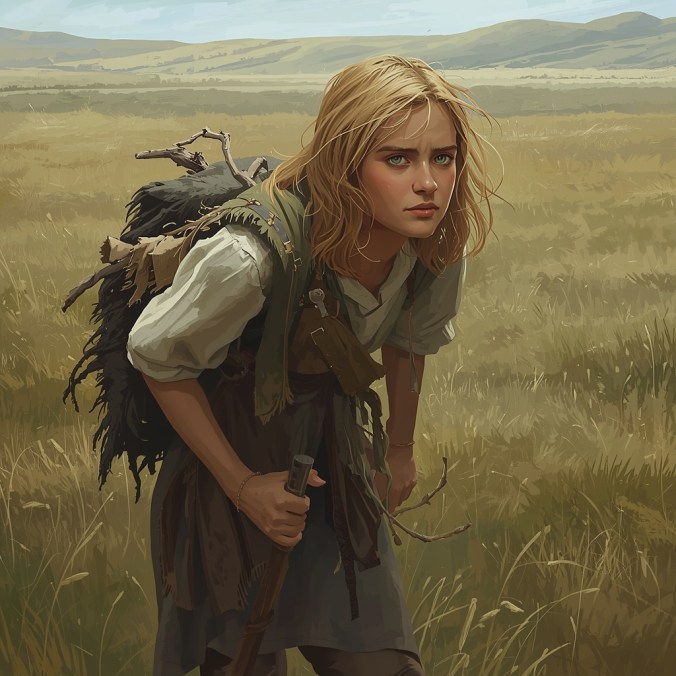
She shouldered the knapsack, cut a branch for a walking stick, and turned her back on the waterhole.
* * *
The grasslands between the ridgeline and the coast had no interest in her suffering.
The sun climbed and beat down with a flat, impersonal heat, and her leg sent pain up into her hip with every step, and the grass stretched out in every direction, looking exactly the same as it had an hour ago. She set her jaw and walked. There was nothing else to do.
She thought about Alax — not bitterly, or not only. She thought about what it might feel like to walk toward something. A fire. A face that knew you.
She thought about Thornhaven. About her mother’s kitchen, the particular smell of it. About how certain she’d been, once, that she understood the shape her life was going to take.
She thought about Grandmama — not the tools, not the words she’d planted in Faline like seeds without telling her what would grow. The voice. The sharpness of it. Even the cruelty had been company.
Weak, she heard, in the way you hear something that isn’t there. Humans are soft and needy, and you are the worst of them.
She almost laughed. Her own head, doing its best impression. Whatever was left of the old woman now lived in the shape she’d pressed into Faline’s thinking — and apparently that shape included insults.
She kept walking.
* * *
She smelled the Gulf before she saw it. Salt and something ancient underneath, something that had no name. She crested the last rise, and it spread out below her — white dunes glowing amber, and beyond them the Gulf of Aruna, flat and enormous and silver green all the way to the edge of the world.
She stopped.
Something in her chest came loose without warning — not grief, not relief, not anything she had a clean word for. Just a shift. Like a stone rolling off.
It had been here before Thornhaven. Before the Old Ways, before Grandmama, before whatever she’d done wrong or right or both at once. It would be hereafter. It did not know her name and did not need to.
She stood there longer than she needed to, leaning on the walking stick, the wind pressing against her face. When she finally moved, it was because her leg reminded her it existed.
A rocky promontory rose to the east, jutting out into the sea. Shadowy recesses dotted the cliff face. She studied them. Maybe a cave. Maybe something to crawl into and close off at the entrance and sleep without one eye open for the first time in weeks.
Worth a look. At the moment, it was all she had, and she’d learned to work with that.
* * *
The climb hurt. She did it anyway.
By the time she reached the cave, it was smaller than she’d hoped, but she fit, and a second hollow nearby held her things. She ate the last of the jerky wedged into the rock, watching the sun go flat and orange on the water below.
The waves came in and pulled back. Came in and pulled back. She watched them do it until her eyes were heavy, and somewhere in the rhythm of it, she stopped waiting for something to go wrong.
She fell asleep before full dark.
* * *
The leg woke her twice, the pain sharp enough that she surfaced gasping. Each time, nothing — just moonlight spreading itself across the Gulf, and the surf doing what the surf did, indifferent and steady. She let it pull her back under.
No dreams. Or none she carried into the morning.
* * *
She lay still when she woke, looking at the rock ceiling, feeling the ache in her leg and the cold at her back and the hunger sitting patiently in her stomach.
Well, here you are.
Not Faline of Thornhaven — Thornhaven had made that clear enough. Not Grandmama’s student, not anymore, or not exactly; the teacher was nearly gone, and the student was left with a shelf of tools she only half understood and a healthy fear of using them. Not Alax’s foundling. Not anyone’s anything, as far as she could tell.
Just a person on a cliff above a sea. Hurt leg. Empty stomach. Still breathing.
She lay there a moment longer with that thought, turning it over. It wasn’t much. But it was entirely, uncomplicatedly hers — and that, she realized, was something she hadn’t been able to say about very much in a very long time.
She crawled out of the cave and began the careful climb down to the beach.
 Greg C. Miller, Author