The House Un-American Activities Committee (HUAC) was an investigative committee of the United States House of Representatives, created in 1938 to investigate alleged disloyalty and subversive activities by private citizens, public employees, and those organizations suspected of having communist ties. It became a standing (permanent) committee in 1945, and from 1969 onwards, it was known as the House Committee on Internal Security.
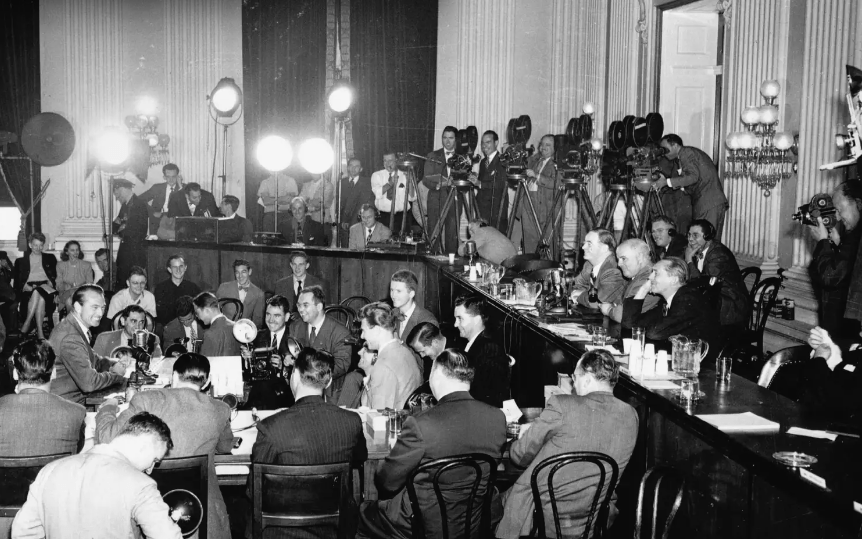
HUAC was most active during the 1940s and 1950s, during the height of the Cold War. The committee investigated a wide range of people and organizations, including suspected communists, labor unions, and civil rights groups. HUAC’s investigations often led to blacklisting, the denial of employment to people suspected of communist ties.
HUAC’s methods were often criticized as being unfair and biased. The committee was accused of using its power to silence dissent and to punish people for their political beliefs. HUAC was also criticized for its focus on communism, which some saw as a distraction from other important issues.
HUAC was dissolved in 1975. However, its legacy continues to be debated. Some argue that HUAC was a necessary tool to protect the country from communism, while others say that it was a tool of oppression that violated the First Amendment right to free speech.
Here are some of the most notable investigations conducted by HUAC:
- The investigation of the Hollywood Ten, a group of screenwriters and directors who were blacklisted for refusing to answer HUAC’s questions about their communist affiliations.
- The investigation of Alger Hiss, a State Department official who was accused of being a Soviet spy. Hiss was convicted of perjury and sentenced to prison.
- The investigation of the Rosenbergs, a couple who were convicted of espionage for the Soviet Union. The Rosenbergs were executed in 1953.
The HUAC investigations had a significant impact on American society. They helped to create a climate of fear and suspicion, and they led to the blacklisting of thousands of people. The HUAC investigations also contributed to the decline of the Communist Party in the United States.
Source: http://en.wikipedia.org/wiki/House_Un-American_Activities_Committee
Photo Attribution
Title: House Un-American Activities Committee Hearing
Date: 1950s
Photographer: Corbis/Bettmann
Source: Library of Congress
Description: This black and white photograph depicts a HUAC hearing in the 1950s. The committee members are seated at a long table, facing witnesses who are testifying. The photograph captures the seriousness and tension of the hearings, which were often used to investigate alleged communist activity in the United States.
 Greg C. Miller, Author
Pingback: History of Censorship (20th century and beyond) | Greg C. Miller, Author