Given that the pre-history of the United States involved the arrival of intolerant religious fundamentalists, it is not a surprise that the drive toward censorship was baked early on into the country’s DNA. The same can be said about free expression, as it emerged from the Age of Enlightenment and eventually found its way into the Americas. This evolution set the stage for greater tolerance of opinions and the need to protect the right to express oneself. The need to express quickly ran afoul of the cultural tradition of suppression, leading to an inevitable and ongoing conflict with autocratic desires to squelch dissent and force compliance.
The founders of the United States recognized this tension when they established the Bill of Rights. Even so, the history of censorship in the United States is long and complex. Despite the First Amendment to the U.S. Constitution guaranteeing freedom of speech, there have been many attempts to censor information and ideas throughout American history.
The earliest examples of censorship came during the colonial period. In 1650, the religious zealots of the Massachusetts Bay Colony passed a law that prohibited the printing of any book without the government’s permission. This law was used to censor various materials, including religious texts and political pamphlets. This example pre-dates the existence of the United States and its constitution but is included here as a historical precedent.
In the 18th century, the oppressive British government began censoring materials considered seditious or critical of the monarchy. This censorship was extended to the American colonies during the Revolutionary War. After the war, the new American government continued censoring materials considered a threat to national security.
National security is widely definitive, but in terms of the First Amendment, it is often used to perpetuate control of the state at the expense of individual liberty. As in the case of the United States slaveholding founders, national security meant anything that was a threat to their “unique” way of life. Case in point is the concept of the “Slave Bible.”
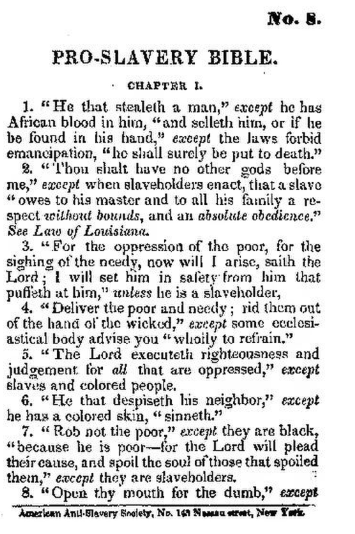
The Slave Bible was a version of the King James Bible edited specifically for enslaved people. First published in 1807 by the American Bible Society, it was the only Bible allowed to be owned by enslaved people in many states.
To that end, the Slave Bible was edited to remove passages that might be considered subversive or dangerous to the institution of slavery (aka “National Security”). For example, passages about freedom, equality, and rebellion were removed. Additionally, the Slave Bible included passages that intended to teach enslaved people to obey their masters and to be content with their lot in life.
The Slave Bible was a controversial publication and was criticized by both abolitionists and slaveholders. Abolitionists argued the Slave Bible was a tool of oppression and designed to keep enslaved people in their place. Slaveholders argued that the Slave Bible was a necessary tool for maintaining order and discipline among the enslaved population.
The Slave Bible was discontinued in the early 19th century as the abolitionist movement gained momentum. However, it remains a powerful symbol of the racism and oppression that enslaved people faced.
Details about the Slave Bible:
- Edited by a committee of slaveholders and clergymen.
- Included 39 books from the Old Testament and 27 from the New Testament.
- Printed in a small, easy-to-read font.
- Sold for a meager price, making it affordable for enslaved people.
- Distributed to enslaved people by plantation owners, churches, and the American Bible Society.
The Slave Bible is a reminder of how the Bible has been used to justify and perpetuate oppression. But even the collusion of slaveholders and organized religion failed to stifle the resilience of the human spirit and the determination of enslaved people to fight for their freedom.
In the 19th century, censorship focused on suppressing information about sex and violence. For example, many states passed laws that prohibited the sale of “obscene materials.” The Comstock Act of 1873 was one of the most famous examples of this type of censorship. This law banned the mailing of any materials considered to be obscene, including birth control information and literature about abortion. In light of the repudiation of Roe v. Wade, don’t be surprised if a Comstock Act equivalent rises from the grave to grab the throat of free speech once again.
 Greg C. Miller, Author