The shade was a small mercy.
Gall had not intended to stop, but the oak had stood at the crest of the hill like an old argument, its canopy wide enough to swallow the afternoon heat, and he had found himself dismounting without quite deciding to. His horse cropped grass nearby. He sat with his back against the trunk and closed his eyes.
Something was wrong with the world. Or rather, something additional was wrong with it.
He had felt the Mordwahl weakening for months — a slow bleed at the edges of his awareness, like pressure behind a wall that was taking on water. He had told himself it was the natural decay of old magic, that the barrier would hold a while longer, that there was time. He had been occupied with other things. The Grand Council had been moving pieces across Westfal’s political board with the patient deliberateness of men who believed destabilization was a tool rather than a catastrophe, and Gall had been moving against them with equal patience, and the Mordwahl’s slow failing had been the thing he kept meaning to address when the other business was finished.
The other business was never finished.
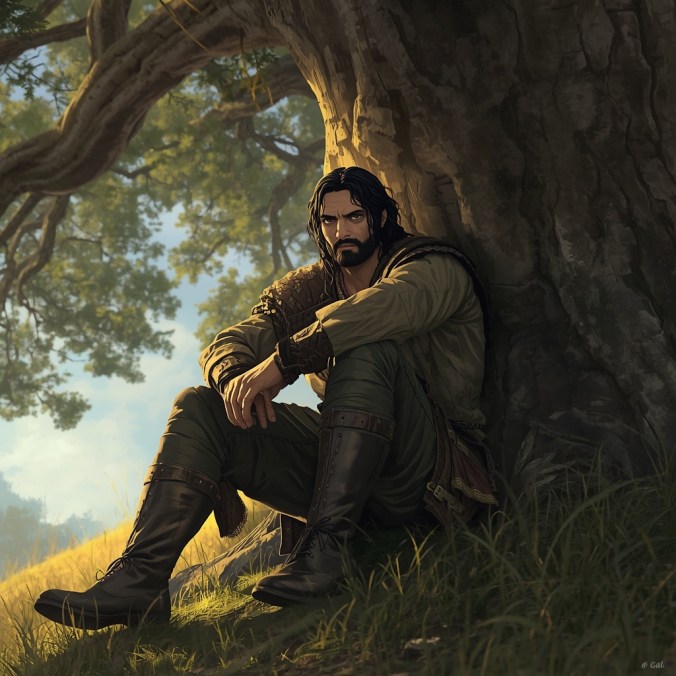
And now the wrongness had changed quality — no longer the slow background ache of something weakening but something sharper, more specific. His magic had been responding strangely for weeks, but the character of the strangeness had shifted — not the dull ache of decay but something closer to absence, as though whatever the Mordwahl had been containing was no longer there to be contained.
He pressed his fingers into the grass and felt the earth beneath it, solid and indifferent, and the thing he hadn’t let himself think became, in the shade of the oak on a hill in the afternoon heat, impossible to avoid thinking any longer.
The bark against his back shifted.
Not the settling of old wood, not the creak of wind through branches. Something intentional. He was on his feet before the thought completed itself, hand at his Mordblade, and then he stopped.
The tree was changing.
The rough furrows of the bark smoothed and lightened, the trunk narrowing, the shape of it becoming unmistakably feminine until a woman stood where the oak had been — or something wearing the form of one. She was tall, pale as birchwood, her hair the deep green-brown of heartwood, her eyes the particular gold of late afternoon light through leaves. She regarded him with the calm of something that had never needed to hurry.
Gall let his hand fall from his blade.
“You could simply send a messenger,” he said. “Like anyone else.”
“We are not like anyone else.” Her voice had the quality of wind through branches — present everywhere at once, coming from no particular direction. “Neither are you, Brin Shar, though you persist in pretending otherwise.”
He bristled at the epithet, fixing the Caretaker with a stony look. “What do you want?”
She tilted her head, considering him the way a tree considers weather — patient, absorbing. “You have been feeling it.”
It was not a question. He didn’t answer.
“The Mordwahl is failing,” she said. “Faline has been free for three months.”
Gall was quiet for a moment. Three months. He had felt the change in his magic and told himself it was decay, not escape, because escape was worse, and the other business needed handling, and he had not wanted it to be escape.
He had been wrong, and the wrongness had cost three months.
“I suspected as much,” he said. “Where is she now?”
The Caretaker’s golden eyes held no apology for the delay in telling him. They never did. “We have reason to believe she has gone to Drachnor. What she intends there, we cannot see clearly. Her chaos magic obscures our sight.”
“You want me to find out what she’s doing.”
“We want you to confirm it. And to understand the scope of it.” A pause. “We do not need to tell you what she is capable of, Gall. And you are already aware that the Grand Council has been weakening Westfal’s kingdoms from within. Two destabilizing forces moving through the same world at the same time — even without collaboration between them — is considerably worse than one.”
“There could never be collaboration between them,” Gall said. “Faline would sooner consume the Grand Council than work alongside it.”
“Yes,” the Caretaker said. “Which is precisely why two forces are worse than one. She will not spare what they have weakened. She will simply take it.”
He looked at the place where the oak had stood. There was no stump, no mark in the earth. Just grass, as though the tree had never been.
“Alric,” he said. “His foresight —”
“May serve you, yes. Or not. We leave the method to you.” Her form was already beginning to soften at the edges, the woman becoming suggestion, becoming light through leaves, becoming nothing. “Do not take too long. She has had three months already.”
She was gone. His horse looked up from its grazing, unconcerned.
Gall stood alone on the hill and felt the thing he had been hoping was not true settle into certainty at last.
* * *
Wolfbern was a city that had never bothered to apologize for itself.
Gall had been here before, years enough ago that the faces in the streets were all different, though the streets themselves were unchanged — broad and practical, stone-paved against the mud of hard winters, the buildings timber-framed and solid, built by people who understood that weather was not a visitor but a permanent resident. The palace rose at the city’s heart with the same philosophy: imposing without ostentation, its towers square and functional, its walls the grey of the mountains that framed the horizon to the east.
He had always respected that about Cazidor. It did not pretend.
The guard captain who received him at the palace gate was a weathered woman who took one look at Gall and made the swift calculation that most people made — that here was someone it would be inadvisable to turn away — and sent a runner ahead before escorting him through the gate herself. The palace yard was busy with the ordered activity of a working court: grooms, officials, a cluster of guardsmen drilling near the eastern wall. Functional. Purposeful. Alric’s court had always reflected Alric.
“I’m here to see the King,” Gall said.
The guard captain’s expression told him everything before the words came.
“His Majesty is away, my lord. He departed three weeks ago with the Crown Princess. He is not expected back for another month at least.” A pause, measuring him. “If you would care to wait, I can have rooms prepared —”
“No.”
He stood in the corridor after the captain moved on and ran through it the way he ran through most problems — systematically, without sentiment, looking for the workable option.
Find Alric. He knew the direction Alric had gone — southeast, toward the coast, with Britta. Three weeks away at riding pace, and then three weeks back, and the month the captain had estimated was probably optimistic. He didn’t have a month. He didn’t have three weeks. Faline had already had three months to build whatever she was building in Drachnor, and every week he waited was another week she spent doing it.
Go himself. He had considered this on the road to Wolfbern and rejected it. He could ride to Drachnor. He could observe what was visible on the surface. But Faline’s real work was never visible on the surface — it was in the minds she had locked and the loyalties she had purchased and the threads of influence she had woven through whatever court she was infiltrating. He would see a woman who appeared to be an advisor, or a merchant, or a healer. He would not see what she had already done. Going blind against Faline was how people died badly.
What he needed was someone who could follow her memory thread from the Mordwahl and show him what the weeks since her escape had actually looked like. What she had done. Where she had gone. Who she had taken.
He needed a memory-walker.
Alric’s foresight was not the same thing, but it was the closest he’d been able to think of on the road here, and Alric was a month away, and there was one other option. An option he had been aware of since before he left for Wolfbern and had not allowed himself to consider directly, because considering it directly meant acknowledging why it made him uneasy, and he had not been ready to do that.
He was out of alternatives. Which was not the same as being ready, but would have to serve.
“Is the Queen in residence?” he asked.
“She is.” The captain’s tone carried the particular neutrality of someone choosing their words carefully around an unknown quantity. “I’ll have you announced.”
She led him through corridors that had the well-worn quality of a palace inhabited — tapestries chosen for warmth rather than ceremony, the stone floors worn smooth by generations of foot traffic, the distant sound of voices from somewhere deeper in the building. A working palace. A home. Gall walked, not letting himself think about what he was walking toward.
He had known Aurea’s lineage when he chose to come here. He had known, in the abstract way of a man who has lived long enough to track family lines across generations, that Astrid’s blood ran in her veins. He had told himself it was irrelevant. He had told himself he was prepared for whatever resemblance time and inheritance had produced.
The captain stopped before a set of doors, spoke quietly to the guards flanking them, and one slipped inside. A moment passed. The door opened.
“Her Majesty will see you.”
She might look like her. She very well might.
The Queen of Cazidor looked up from the worktable as he entered, and Gall stopped walking.
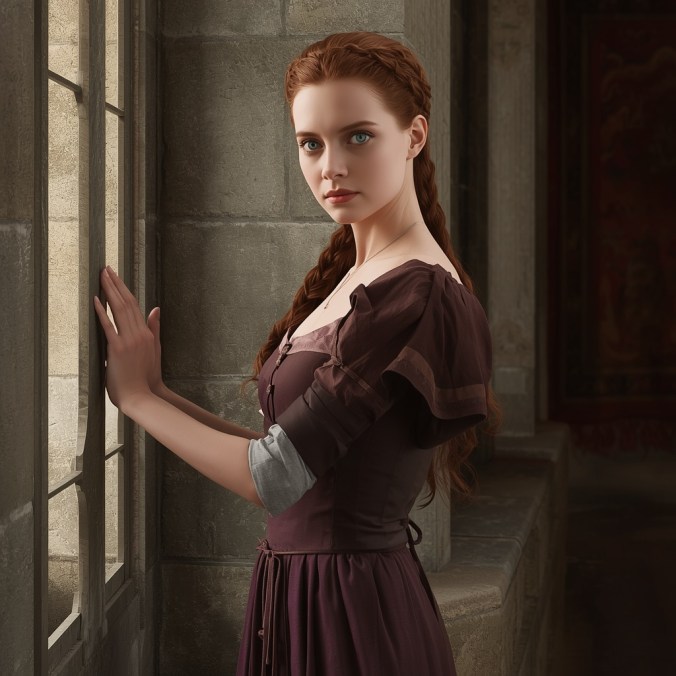
She was red-haired and blue-eyed and looked so much like Astrid that the breath went out of him. He hoped it didn’t show. Only a moment — he covered it the way he covered most things, with stillness, with the careful blankness of a man who had spent centuries learning not to show what moved through him. But the moment was there, and it cost him, and he understood with cold clarity that he had not been as prepared as he had believed.
Aurea rose from her chair with the unhurried ease of a woman entirely at home in her authority. She was dressed practically for a queen — her hair loosely bound, her sleeves pushed back from whatever work had occupied her before his arrival — and there was something in her bearing that was purely herself and no one else. Direct. Warm. Entirely unimpressed by whatever quality had given the gate captain pause. That helped, marginally.
“You’re Gall,” she said. Not a question.
“Your Majesty.” He inclined his head — not the deep bow of a subject, but acknowledgment of her station. “I had hoped to speak with the King. I apologize for arriving unannounced.”
“Alric has mentioned you.” Her blue eyes assessed him with a frankness that felt familiar in ways he had no intention of examining. “He didn’t mention you were coming.”
“He didn’t know.” Gall moved further into the room as the doors closed behind him. “The matter concerns Faline.”
Something shifted in her expression at the name — not surprise, but a careful stillness that told him she understood the weight of it. A queen who paid attention. Of course she did.
“Alric won’t be back for a month,” she said.
“So I was told.”
The silence between them had a quality to it — not uncomfortable exactly, but charged in ways he couldn’t entirely account for and refused to examine too closely. Aurea looked at him with those eyes that were not Astrid’s eyes, that only looked like them, and Gall kept his attention fixed on the problem at hand and not on the thing happening somewhere beneath his composure that had absolutely no business happening.
“Sit down,” she said finally, with the quiet authority of a woman accustomed to being obeyed. “And tell me what you need.”
* * *
She did not sit again after he did. Instead, she moved to the window, looking out over the palace yard with the particular stillness of someone thinking rather than simply standing.
“Faline,” she said. The name sat differently in the room now that she’d had a moment with it. “Alric has never spoken of her as a present concern. A historical one. A cautionary one.” She turned from the window. “You’re telling me she’s neither.”
“She escaped the Mordwahl three months ago,” Gall said. “She is in Drachnor. What she is doing there I don’t yet know, but Faline does nothing without purpose, and Drachnor shares a border with Bretagne.”
Aurea absorbed this without visible alarm, which told him something about her. “The legends say she was the High King’s Druid. That she controlled him.”
“For the better part of his reign, yes.”
“They also say she died when he did.”
“They say a great many things about her.” Gall kept his voice even. “Most of them are wrong. She was contained. There is a difference.”
Aurea’s blue eyes held his with a steadiness he found both familiar and uncomfortable. “And the Mordwahl held her for seven hundred years.”
“Yes.”
“Until it didn’t.”
“Yes.”
She moved away from the window and sat, not behind the worktable but in the chair across from him, which struck him as deliberate — closing the distance, placing them on equal footing. She understood the geometry of conversation.
“What do you need from Alric?” she asked.
“His foresight. I need to confirm what Faline is doing in Drachnor before I move against her. Acting on incomplete information where she is concerned is how people die.” He paused. “I had hoped he could show me something of her current movements. Possibilities, at least, even if not certainties.”
“Alric’s foresight doesn’t always deal in certainties,” she said, with the careful tone of someone who knew this from long experience.
“I know. But possibilities are more than I have now.”
Aurea was quiet for a moment. When she spoke, her voice was measured, as though she had been turning the words over before releasing them. “I have memory-walking abilities. Well-developed ones. Britta has inherited them from me, though hers have not yet manifested.” She looked at him steadily. “You know this.”
It was not an accusation. But it was not entirely not one either.
“I know your lineage,” he said carefully.
“Then you know why you’re still sitting in that chair instead of riding after Alric.” She folded her hands in her lap. “Tell me how it would work.”
Gall told her. The Mordwahl was perhaps a week’s ride to the southeast. Faline had escaped from there three months prior — the memory of her escape would still cling to the place, faint but traceable, the way a fire’s heat lingers in stone long after the flame is out. From that thread, a skilled memory-walker could follow the trail forward in time, tracking Faline’s movements, building a picture of her intentions.
“The closer to current events the memory-walk reaches,” he said, “the more dangerous it becomes. Faline’s chaos magic makes her unpredictable even in memory. If she were to become aware of the walk —” He stopped.
“What happens if she becomes aware of it?”
He held her gaze. He had promised himself honesty. “It could kill you. But I want to be precise about what that means, because with Faline, ordinary death is not the worst outcome.”
Aurea said nothing. She waited.
“Faline is an anamgnoth,” he said. “A soul taker. It is part of what she is — her nature and her dark art and the chaos magic in her blood combined into something that has no clean category in the ordinary understanding of what magic can do.” He kept his voice level, which cost him something she probably noticed. “She doesn’t simply kill. She consumes. The soul, the memories, everything that made the person who they were, was taken and used to extend her own life. What remains is a body that was a person. There is nothing left of what that person was.”
He had said it flatly and without decoration because decoration would have been obscene. He had watched it happen. More than once, in the years before he understood what he was serving — before he had turned on Faline when given the chance, partly because of what he had witnessed her do. He knew the specific quality of the absence afterward. The way the air around the person changed before the body even stilled.
“If she becomes aware of the walk and chooses to act rather than simply expel you —” He stopped. Started again. “That is what she would do. Not kill you. Consume you.”
The silence in the room had a different quality now.
“How likely is that?”
“I don’t know,” he said, and hated that it was true. “Her chaos magic operates beyond what I can predict. I would be with you through the walk. I would do everything in my power to pull you out if something went wrong.” He paused. “I want you to understand that I am not certain that would be enough.”
“You’re giving me the right to refuse,” she said.
“Yes. With full knowledge of what refusal would mean and what agreement would risk. I won’t dress it in softer language than it deserves.”
Another silence. Aurea looked at her hands for a moment, then back at him. When she spoke, her voice was quiet but entirely without hesitation.
“I have a daughter,” she said. “Britta is seventeen years old. She will inherit this kingdom. She will rule it, and raise children in it, and grow old in it.” She paused. “Faline was contained for seven hundred years, and the world was still shaped by what she did before her containment. She is loose now, during my daughter’s lifetime. During Britta’s reign.” Her blue eyes were very steady. “If there is something I can do to understand what she intends — to give you what you need to stop her — then refusing is not something I’m able to do in good conscience. Whatever the risk to me.”
Gall looked at her and said nothing for a moment.
Whatever the risk to me.
She knew now exactly what that risk was. And she had said it anyway.
He should have said something then. He should have pressed harder still, found some argument he hadn’t yet made. He knew this even as the moment passed. Instead, he heard himself say, “We would need to leave within the day. The memory thread will only grow fainter.”
Aurea nodded once, with the decisiveness of someone who had already made her peace with the decision. “Give me two hours to make arrangements for the palace in my absence.” She rose, signaling the end of the audience with the same quiet authority with which she had conducted it. “And Gall.”
He paused at the door.
“Whatever Alric has told me about Faline,” she said, “I suspect the truth is considerably worse.”
“Yes,” he said. “It is. You’ve now heard most of it.”
He was nearly at the door when she spoke again.
“Before you go.” Not a request — the tone of someone who had moved on to the next thing. “Tell me what we’ll need.”
He turned. She had already moved back to her worktable, pulling a sheet of parchment toward her with the efficient manner of a woman who processed decisions by acting on them.
“Travel light,” he said. “Bedrolls. Provisions for a week, though I’d plan for ten days in case the thread takes longer to follow than expected. Plain clothing — nothing that marks you as who you are. We’ll camp rather than seek inns. The fewer people who see us the better.”
“Which roads?”
“Southeast out of Wolfbern, then into the lower foothills. We’ll leave the main roads after the first day.”
She was writing. “Horses.”
“Your own and mine. We move at pace — not punishing, but consistent. Long days.”
“My mare can manage long days.” She said it without defensiveness, simply correcting a potential assumption. “What about provisions — hardtack and dried meat, or are we allowed actual food?”
“Whatever you can carry without slowing us down.”
She looked up from the parchment with an expression that suggested she was filing whatever you can carry under his problem, not hers. “I’ll have the kitchen prepare something practical. I have some experience of what keeps and what doesn’t.” A pause. “I assume your definition of bare minimum and mine may not be identical.”
“I’d assume the same.”
“I’ll err toward yours,” she said. “Within reason.” She set down the quill and opened the small chest on the corner of the worktable, and he saw her draw out a knife in a worn leather sheath — not a decorative piece, not a court ornament, but something that had been carried and used. She set it on the table beside her parchment with the matter-of-fact ease of someone adding it to a list.
He looked at it. The hilt bore a crest he recognized — not from any heraldic record, but from its particular shape, the motif worked into the metal. A lineage marker. Old. The memory-walker’s mark, worn smooth with handling, on a knife that had clearly been carried for years and not merely kept.
“You’re bringing that,” he said.
“I am.” She glanced up at him. “You’ll be armed. That covers most situations. Not all of them.”
He said nothing for a moment, looking at the crest on the hilt.
“No,” he said finally. “Not all of them.”
She set the knife aside and reached back into the chest. What she produced next was smaller — a golden pendant on a worn chain, round and smooth, no larger than the palm of her hand. Along the edge were symbols of the sun, moon and stars. She set it beside the knife with the same matter-of-fact ease, but something in the care with which she placed it was different.
He looked at it for a longer moment than he intended to. Recognition slowly asserted itself. Not from any transaction or record, but from the lineage itself — the compassus memoriae, passed down through the women of her family line who carried the memory-walking gift. He had not known it still existed. That it was here, on this table, beside a knife with the same family’s crest, told him something about Aurea he hadn’t needed to be told but felt anyway.
“You’re bringing that as well,” he said.
“I only carry it when I need it,” she said. “I need it.”
He looked at the table — the knife, the pendant, the parchment with its practical list — and then looked away.
“Meet me in the palace yard in an hour,” he said.
“Two,” she shot back, but with a smile.
He nodded and walked back through the corridors with the cold understanding that he had just let a woman agree to something he should have argued her out of, and that he had not argued because he needed her, and that somewhere beneath the need was something he refused to name that had recognized her the moment she looked up from that worktable — and that the knife on her table, with its worn crest and its quiet readiness, had not helped matters at all.
He had made this mistake before.
Not with her. But close enough.


Pingback: Astrid’s Reflection: Astrid (A Westfal Story) | Greg C. Miller, Author