Rough hands shook her awake. She looked up to see Papa looking at her, his face unreadable in the pre-dawn darkness. “Get up and get dressed. You’re coming with me.”
“Where are we going?” Faline asked, her heart suddenly racing with an excitement she couldn’t quite name.
Papa stared, then said, “Hunting. Get your things, I’m already prepared. Some food is on the table.”
Faline’s heart leaped as she dressed. She was going hunting after all. The nightmare of the last few days was being forgotten. She pulled on her warmest animal skin traveling clothes and packed a change of clothes. All these she put into a shoulder bag.
She walked over to the table. Mama huddled at the end of it, head bowed as if staring at the table surface. A few sniffs and snivels came from her, but she refused to look up.
“Mama,” Faline said. “Are you okay?”
She nodded rather than replied.
Faline grabbed an apple and a hard hunk of cheese. It would have to do for breakfast. A smaller bag sat next to Mama.
Papa stood behind her. “Let’s go. We have far to travel. I want to be there by nightfall.”
“Okay,” Faline said. “What are we going to hunt?”
“Elk,” Papa replied a bit tiredly. “They are plentiful this time of year.”
“Take this food sack,” Mama said, in such low tones that Faline barely understood her.
Faline reached to take it from Mama’s outstretched hand, but the woman let go of it and withdrew back into her huddled posture. Faline seized hold of the bag and tucked it into her knapsack.
The door opened, Faline turned to see Papa standing there, staring out into the darkness. “Make your goodbyes and let’s go,” he said without looking at her.
“Goodbye, Mama,” Faline said to the huddled mass next to the table. Gentle sobs carried in the air. Ravael’s death has affected her greatly, Faline thought. “I’ll see you when we get back.”
She reached to touch Mama, but she turned away, as if unable to stand the young girl’s touch.
Or maybe she’s just tired, Faline told herself, pushing away the uncomfortable feeling in her chest. We’ll talk when I get back. Everything will be fine.
Faline turned away and followed Papa out the cabin door, into the still dark air of the settlement. A bit of a glow painted the tops of the trees as the sun prepared to make its entrance. Clouds, a rarity in these last few months, hung in the sky, hinting at but not promising rain, which was so desperately needed.
“Follow me,” Papa said, and she did, passing between the scattered cabins of the settlement, winding their way north, toward the far distant Dunharrow Mountains, and where the hunting grounds of the Elk lay.
Near the outer boundary of the settlement, a lone cabin squatted, and a tattered trail of smoke rose from the fire burning in its fireplace. As they neared, the door opened, and Kristoff stood in the doorway, watching them with narrowed eyes as they moved beyond the cleared trees and disappeared into the paths that led north.
* * *
Papa set a fast pace, so much so that Faline had a hard time keeping up. Soon, he was so far ahead that she’d soon lose sight of him altogether.
“Stop,” she shouted.
He did, then turned and, in his typical laconic fashion, waited for her to catch up. For a while, she could make out the path based on landmarks shared by the boys in the settlement, but once beyond the far ridge that marked the furthest extent of the settlement, she no longer had a point of reference.
The trail, that is, what there was of it, narrowed and wound around numerous rocks and tree stumps. At the bottom of a ravine, Papa stopped and looked around for several minutes.
“Are we lost?” Faline asked.
“Not quite,” he replied. Then he turned and followed the ravine upstream until it branched off into several different directions. Seemingly at random, he took one and crept up it until reaching the top of a cliff.
Her heavy limbs protested more exertion. At the next opportunity to catch her breath, she asked, “Are we about ready to stop? I don’t think I can go much farther.”
“Just over the next hill,” Papa said, and then pulled himself up onto a large rock. “Come look at this.”
Irritation competed with the sweat stinging her eyes. Yet she scrambled up and, with his help, found herself on a large rock plateau. Scraggly trees in clumps lay stretched out before her, as well as a steep slope leading down to a thick forest. Many miles away, just beyond the far edge of the woods, lay shimmering waters stretching as far as the eye could see.
“What is that?” she asked, her exhaustion momentarily forgotten.
“The Gulf of Aruna.”
She peered at it. Never had she seen such a large body of water. It stretched to the horizon. Wait? There was something on the horizon, almost out of sight. She squinted at it, rising like a white column. “Is that an island?”
“Yes,” Papa answered, “It is called Avalir.”
“Does anyone live there?”
“Yes, some people called Druids.”
“Are they like us?”
“Sort of.” He looked around and then pointed to a copse of trees about a half-mile away. “We will make camp over there.”
Faline kept her eyes on the far-distant island. “What do you mean, sort of? Are they human?”
“Yes, human. Follow me,” he said, moving on.
They moved further north, until just under the colorful leaves of the trees. Some distance into the woods, they could hear water burbling. “We will make camp here.”
Faline took in the wonder of the area, the colorful tapestry of fall foliage, contrasting with the broad whitish gray expanse of stone that formed most of the ridgeline behind them. Then, in the far distance, a line of blue contrasted slightly against the azure sky. It was wondrous to behold.
“Where do we find the elk?” Faline asked.
“They will come at dawn to drink from the spring in these woods and a salt lick nearby.” He pulled out a small bow and a quiver of arrows and handed them to her. “Let’s work on getting you ready.”
She took hold of the weapon and stared at it. She’d seen the boys in Thornhaven practicing, and had so wished she could try as well. Now, not only was she outside the settlement for the first time in her life, but she was also learning to shoot an arrow. Her heart jumped with joy, but when she looked toward Papa, his countenance looked somber, almost grim. “Is there something wrong?”
He stared at her, his face non-committal, but then a weariness passed over it, and he muttered. “Just not enough time, that is all.”
What did that mean? Not enough time for what? But she knew better than to ask; pressed too hard, Papa might treat her to stony silence, as he often did at home whenever she pushed too hard for answers.
So, they spent the afternoon practicing archery, or at least in the attempt. The bow was almost as big as she was. To draw it took most of the strength she possessed, and then some. Adding to her disappointment, the arrows seemed to take on a life of their own, zinging off to the left or right, as well as dropping short of the target. The sense of frustration grew, and Papa must have felt it as well. His breathing quickened, and he transformed from patient silence to grabby insistence.
Not once did she hit the tree trunk she aimed at.
“You must pull back to your cheek; you will never get enough behind the arrow to make it carry to the target.”
“I’m trying,” Faline shot back, feeling annoyed as well as frustrated.
Papa sighed, and for just a moment, his hand trembled as he reached to adjust her grip. “Yes, I know. It’s just…” He trailed off, turning away. “Not good enough.”
He walked away to sit on a rocky outcrop, and Faline thought she saw him wipe at his eyes before he settled into staring off in the distance.
If only she could get the arrows to fly straight and true. The whisper of knowledge came—not Grandmama’s voice anymore, just… knowing. Hawk wind. Use the old ways.
She glanced toward Papa; he stared off in the distance, clearly not paying attention. Now was the time to try.
She nocked the arrow on the bowstring, drew the bow up, and pulled the string to her cheek. Muscles quivered and screamed from the effort, but she held her breath and eyed the trunk some number of feet away. As she let her fingers release the bowstring, she whispered, “Ah-cheepter-ventee.”
A breeze tugged at her long blond locks, and the arrow, which had already started to veer off, whipped back on course and hurtled forward. A solid thunk echoed out as the missile buried itself into the tree.
A wave of satisfaction ran through her as she admired the effect.
“What did you do?” Papa’s voice sounded from behind her. She turned to find him staring wondrously at the result. “How did you do it?”
At first, she was going to tell him, to satisfy that itch inside, to let others know that the Old Ways were not to be feared. But caution convinced her otherwise. Keep others unaware, for they will fear you for what you are.
“I… I did as you showed me.”
He looked at her, doubt crossing his features, but then nodded slowly. When he spoke, his voice was thick. “Good. Remember to always do that, and you should hit your target.” Then a wry smile crossed his face, though it didn’t reach his eyes. “If, of course, you’re hunting trees. To hit a moving animal is altogether another skill.”
He patted her on the head, and his hand lingered there for just a moment longer than usual. “Good work.”
* * *
Later, they moved into the trees and found the water source. It bubbled up into a bowl-shaped depression in the rock, and trees and lichens clung to the edges of the water. At the north end of the spring was a pile of rocks, giving way to a small stream of water leading off across the rock face, eventually, or so she supposed, leading down into the large forest down the slope of the rock formation they stood on.
“Wouldn’t there be more elk down in that forest?” she said, pointing.
“Yes and no. Many elk are in that forest, but the forest itself belongs to the little people of Dunharrow. They do not like intruders.”
She turned to him. “Little people? How little?”
He patted her on the head. “As little as you are now.”
She looked back at the forest. “Are we safe?”
“They don’t come up on the ridgeline because they are much safer amongst the trees. That said, I would not trust them to be helpful. They have their own interests to attend to, and little else interests them.”
“Is there anyone like us around here?”
Papa grew silent, as if measuring his response for whatever reason. “There is—or was—a small fishing village along the coast near where a river empties into the Gulf. But I would not go near it. It is a bad place, full of bad people.”
“Why are they bad?”
He stared at her long and hard. “Because they kill people, and people who do that sort of thing are beyond hope.”
The words hit like a physical blow. Faline swallowed hard. “Oh.”
She noted the sun starting to slide toward the northwestern horizon. “Should we prepare for the night?”
“Yes,” he said with a sigh, glancing back toward where they left their equipment. “I suppose we should. We must gather as much wood as we can to keep a fire going tonight. As the sun gets lower, the animals should come to the waterhole. Then we should be able to catch something to eat.”
For the next hour, they gathered kindling, small logs, and anything else that might burn. The sun was very low in the sky when they finished. Papa called her over to the water hole. “Bring your bow,” he commanded. She did as she was bidden.
The breeze, which had been coming up from the Gulf and carrying a tinge of saltiness, now began to shift and slide down off the ridgeline, bringing much chillier temperatures. She pulled her jacket around her, trying to fend off the icy fingers.
“The wind is something you need to keep track of. Animals can smell us, but we can’t smell them. We have to keep downwind. Do you see where the wind is coming from?”
She nodded. “From behind us.”
“Then we must position ourselves on the opposite side of the waterhole and wait.”
They slipped around to the south side of the waterhole and huddled in the brush, peeking over the edge at the water. Deepening shade began to descend over the area, as the sun settled below the treetops. A reflected glow appeared on the clouds overhead.
Faline yawned, but just as the sleepiness cleared, she heard something stirring in the trees. The brush on the opposite side of the pond parted, and a muzzle appeared. A long face pushed through, smooth and brown, with large donkey-sized ears, topped with a rack of antlers with at least eight prongs.
“It’s magnificent,” Faline said, thoroughly awed.
Papa whispered back, “Aye, he’s a good one.”
The beast lowered its head, and a long tongue dipped into the waters, causing slight ripples in the surface. Faline stared at the beast until a sharp twang to her right snapped her focus.
A missile whistled through the air and buried itself in the shoulder of the mule deer. Faline winced as the animal sprinted away. Papa climbed to his feet and darted after it, fitting another arrow on his bow. All knees and arms, Faline lurched to her feet and struggled to keep up.
For several minutes, they ran pell-mell through the underbrush and then out onto the rocky slopes of the ridgeline. Heart beating in her ears, she felt a sense of relief upon finding Papa standing over the collapsed animal.
As she approached, Papa pulled a long knife out and dug into the flesh. Blood poured onto the rockface in rivulets. The bright crimson streamers drew a sharp contrast against the grayish-white rock.
Faline had cleaned rabbits and chickens at the settlement. Anything larger, men cleaned it apart from where the children were. She hesitated.
He waved her closer. “Come, give me a hand.”
She knelt next to the animal, still awed by its size.
“Here,” Papa said, holding out a long knife, his arm and hand covered in blood. “Take this, we need to gut and skin him before we can get the meat.”
It took them quite a while to strip the animal of all its treasures, not all of which they would be able to use immediately. But Papa had brought sacks for the entrails, skin, and meat. It was a messy business nonetheless, and by the end of it, both had a lot of blood all over them.
They cleaned up as best they could at the water hole, but by then the sun had set.
“Get the fire going. I’ll finish up,” Papa said.
Faline climbed to her feet, her hands and memories now drenched in crimson. She had no illusions about hunting and how dressing game could be slimy and disgusting, but this was the largest animal she’d ever dressed. It seemed such a waste to kill such a magnificent beast, but they needed to eat, and this animal would provide everything they needed.
She washed away all that she could, though the sticky mess crept under her nails and between her fingers in such a way that it might never disappear. In the end, she did what she could and retreated to their campsite to get the fire going.
After piling the kindling into the makeshift firepit, she got the flint and striker and worked it hard. The flint shavings came off hot, but the evening wind was cold, and the kindling did not cooperate.
Papa was hanging the meat in a nearby tree and shouted, “Got that fire going yet?”
The kindling would not start. It smoldered and sputtered but then blew out. She glanced over her shoulder. Papa had finished hanging the meat and was gathering his equipment. She turned quickly and snapped her fingers. “Ignis.”
A flame leaped from her hand into the kindling. It roared to life, quickly spreading to the other material she’d gathered. By the time Papa appeared over her shoulder, flames were licking the branches of the firepit.
“Good job,” he commented without elaboration, then produced some sharpened sticks. “This should suffice for now.”
From a small bag, he pulled some cut-up deer meat and skewered it for both of them.
By now, the fire was producing heat and could presumably be used to cook the meat. So, they sat back and grilled what they had and ate off the skewers. They soon exhausted the meat, but Faline was full, and Papa did not seem inclined to get more. The warm meat in her belly felt good against the cold air probing at them from the ridgeline.
“How old were you when you first hunted?” Faline asked.
Papa stared into the fire. “Seven seasons, I think. My first kill was a bird.”
“Did your Papa teach you to do that?”
“No, in fact, he was mad when I did it.”
“Mad? Why?”
“There was no reason for it. We had enough food, but I killed because I could. Not because it was necessary.”
“Oh,” Faline answered. Ravael’s face surfaced in her memory, but she quickly chased it away. “Did Grandpapa punish you?”
“Yes, he made me go without food for three days, as a reminder that what the Creator provides should not be wasted.” He leaned closer, and though it was dark, the light from the fire glowed in his eyes with an intensity that made her uneasy. “Killing should have a purpose. One that serves the needs of the community, not just the individual.”
She stared at him, her skin prickling at the insinuation. “Unless you’re defending yourself.”
He nodded slowly. “If your life is in danger, and it’s them or you, then yes, killing might be necessary, or even justified.”
She breathed a sigh of relief.
But then he added, his voice quiet and measured, “But who are you to make that judgment?”
“You might not have time to think about that, if it comes to survival.”
“Perhaps. But you do agree that killing should have consequences?”
“All killing has consequences…”
“No, I don’t mean that. Ending a life is a result, not a consequence. Someone has to be held responsible.”
“Even if you are defending yourself?”
“Especially then, because otherwise ‘defending yourself’ becomes a justification for what we’ve done, not a reason for what happened.”
She looked away from him toward the fire. “I suppose that is true.”
“What do you suppose the consequences should be for killing someone without a justifiable reason?”
Nausea crept over her, but she swallowed and kept her composure. “Death?”
“I suppose that could be true, if there were no alternative means of dealing with someone who kills freely.” He paused, and when he spoke again, his voice was heavy with something she couldn’t name. “But sometimes, death is too easy. Sometimes, the one who killed must live with what they’ve done. Must face the consequences every day, for the rest of their life.”
She looked at him, genuinely confused now. “What about forgiveness? Does that mean anything?”
“Forgiveness is always a possibility if one accepts their part in a crime. But there is a difference between being forgiven and justice. For a community, one must accept that justice, no matter how painful it is, must be enforced if we are to live together peacefully.”
He fell silent, staring into the fire. After a long moment, he added, almost to himself, “Even when it breaks your heart to do it.”
Poking the fire, she watched the coals shimmer and glow. Her mind was spinning, trying to make sense of the conversation, trying to push away the growing unease. “I am tired.”
With a sigh, he replied, “As am I. Think about what I said, however. It will make more sense to you tomorrow.”
Probably not, she thought. Still, she rolled over and pulled her blanket over her. “Goodnight, Papa.”
He paused before answering, and when he did, his voice sounded thick, almost choked. “Goodnight, child.”
The fire burned long before dimming, and by that time, sleep had finally crept upon her and taken her away from the sour thoughts and images their last conversation had engendered.
Was she being paranoid, or did he know what happened on the hillside? She doubted it, but the idea stayed there, gnawing on her conscience until at last, fatigue pulled her into the black world of dreams, though she did not have any that she could remember.
* * *
Sunshine crept upon her features as she blinked awake. The fire, almost gone, smoked incessantly but produced no heat. She sat up and looked around, her breath casting clouds of vapor that almost obscured her vision.
Where Papa had been, nothing remained. Had he already packed his things? She looked around, but he was nowhere nearby. Perhaps he’d gone to the waterhole.
She stood, the cold making her joints hurt. Keeping the blanket wrapped around her, she wandered over to the waterhole, but it was empty, except for a few birds which scattered as soon as she arrived.
“Papa,” she called out. She walked around calling his name, louder and louder. Still nothing.
She walked to the tree where the meat had been hanging and found only a single bag hanging from it. Had he taken the meat back to the village? Why hadn’t he woken her? Was he coming back after dropping off the meat? How strange.
Maybe he went to scout for more game, she told herself. He’ll be back soon.
When she returned to the camp, her things were still piled next to where she’d been sleeping. A quick check revealed nothing had been taken. She sat on the ground and tried to take it all in. He’d left without her.
As she was searching, her eyes spied something wrapped up with a bit of twine, next to where Papa’s hunting knife lay. Why did he leave that? Wouldn’t he need it?
She picked up the parcel. It fit into the palm of her hand. She untied the twine and unwrapped the object inside.
A cold shiver ran down her spine.
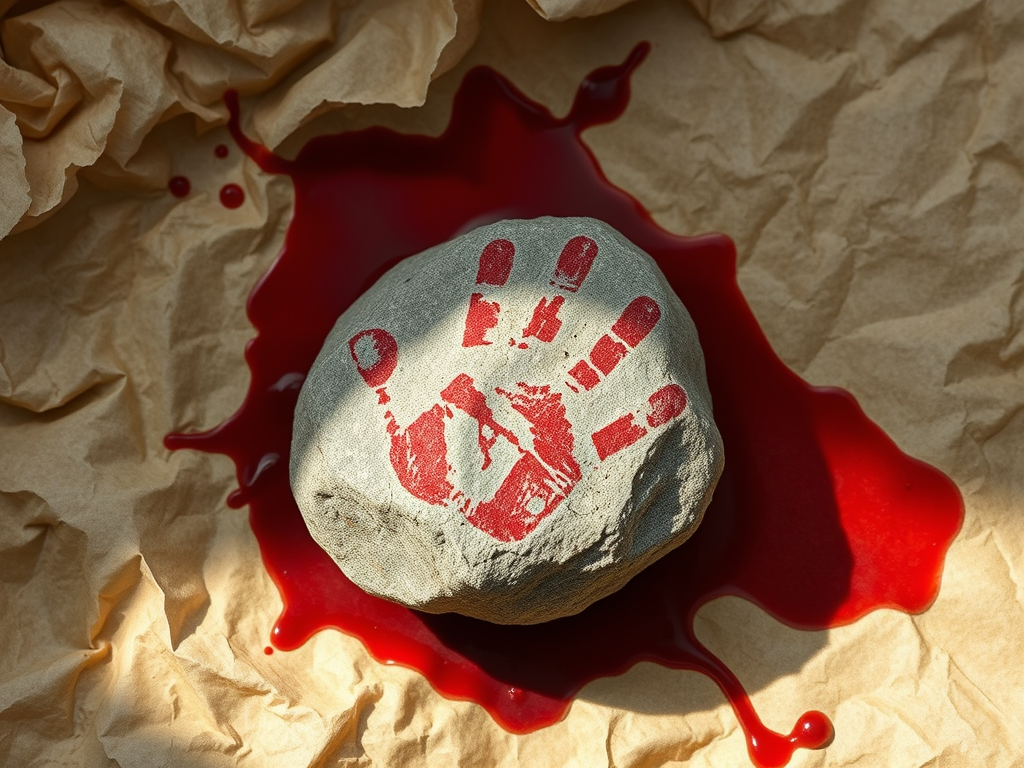
Inside was a rock, with dried blood on it, and a handprint in the shape of her hand. On the inside of the paper wrapper was written a single word: “Justice.”
For a long moment, she stared at it, not understanding. Then, like ice water flooding through her veins, understanding came.
They knew.
Papa knew.
The Council knew.
This wasn’t a hunting trip.
This was exile.
And Mama’s tears—those hadn’t been for Ravael. They’d been for her. For her daughter, whom she’d never see again.
Faline’s hands began to shake. The rock fell from her fingers and landed with a dull thud on the ground.
She was alone.
Completely, utterly alone.
And there was no going back.
 Greg C. Miller, Author