Two years passed, and Thornhaven grew colder toward Faline’s family.
It started small. Old Henrik “forgetting” to save them grain. The blacksmith taking longer and longer to complete Papa’s orders. Children running away when Faline approached, though she’d never done anything to them.
Then came the symbols.
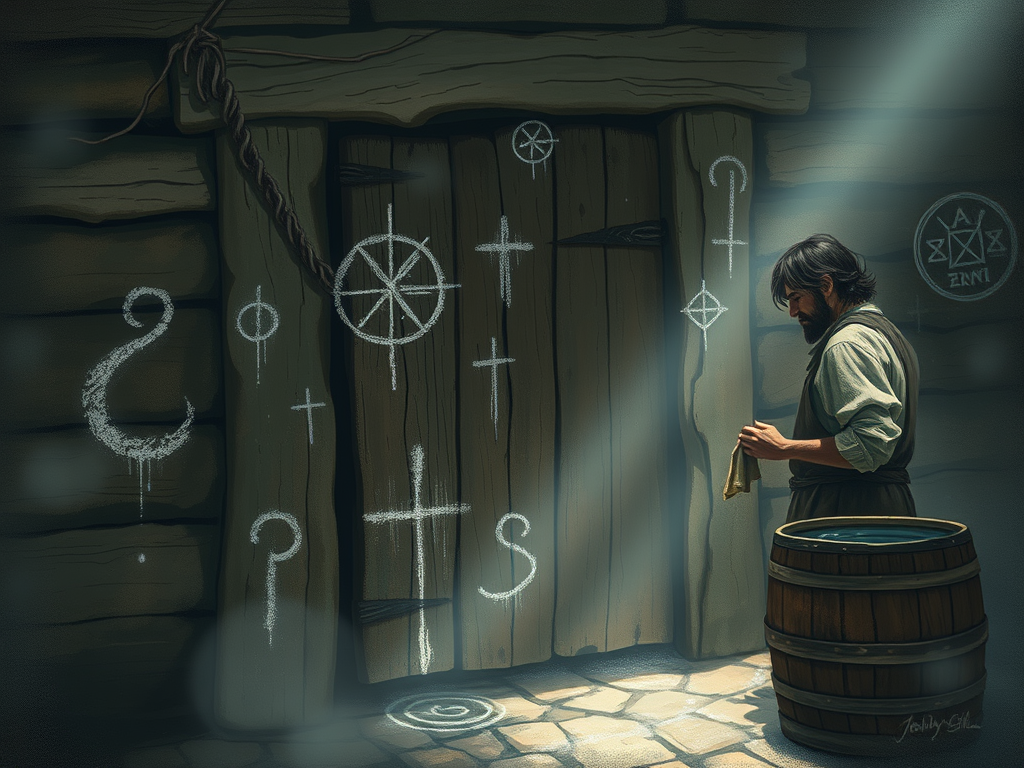
One morning, Faline woke to find crude chalk marks on their door—circles and crosses and strange runes meant to ward off evil. Papa scrubbed them away, jaw tight, saying nothing.
Three days later, they appeared again.
“Let them rot in their superstition,” Grandmama said from her corner. She looked like a corpse that hadn’t realized it was dead yet—skin hanging loose on her bones, eyes sunken deep, hair thin and brittle. But her voice still had strength. “They’re beneath you, child. Beneath us both.”
They are, the voice in Faline’s head agreed. Insects. Unworthy.
Faline was eleven now, and the voice had grown stronger. Sometimes she couldn’t tell if a thought was hers or Grandmama’s. Sometimes she didn’t care.
The lessons had become more intense. Grandmama no longer bothered with gentleness—there was no time for it. She would grab Faline’s hand, cut both their palms, and force the transference through sheer will while chanting the old words. The sessions left Grandmama gasping, sometimes unconscious. But when she woke, she’d demand they continue.
“Show me the killing curse,” she’d rasp. “The one I taught you last week.”
Faline would point at a small animal—a mouse, a bird—and speak the words. The creature would stiffen and fall. Dead in an instant.
“Good. Now the disease curse. The one that rots from the inside.”
Faline hesitated. “But Grandmama—”
“DO IT.”
So she did. And watched as the next mouse died slowly, painfully, over the course of an hour.
“You must know these things,” Grandmama would say afterward, lying flat on her back, struggling to breathe. “The Red Robes knew them. That’s how they controlled us. Fear. They made examples of those who resisted. Made them die slowly, publicly, horribly. So everyone else would submit.” Her hand found Faline’s. “Promise me you’ll never submit. Promise me you’ll use what I’ve given you to stay free.”
“I promise, Grandmama.”
But freedom seemed further away than ever. The settlement’s hostility grew week by week.
Mistress Svenson stopped speaking to Mama entirely. When they passed in the lane, the woman would spit three times and make a warding sign.
Torben told Papa his money was “cursed” and refused payment for work.
The children had long since learned to give Faline a wide berth, but now their parents did too. When she walked to the well, people would turn away, clutching their children close.
No one spoke to Faline anymore if they could help it. When she went to fetch water, people would abandon the well rather than share it with her. When she walked through the lanes, shutters would slam closed ahead of her like a wave.
The symbols on the door grew worse. What had begun as chalk marks became crude drawings—gibbets and stakes scratched into the wood with something sharp. Once, she woke to find animal blood splashed across the threshold.
Papa stopped trying to scrub them away.
Mama stopped looking at Faline altogether.
Faline’s eyes, once a pale green, had grown brighter over these months. Sharper. Sometimes, in certain light, they seemed to glow with an inner fire—a visible mark of what the partial transferences were doing to her. Mama had noticed. “Your eyes,” she’d said one morning, staring at Faline with something like horror. “They’re changing. Just like hers did, before—” She cut herself off and turned away.
It was the last time Mama had spoken to her about anything that mattered.
The weight of it all—the silence, the symbols, the shuttered faces, the slow erasure of any life she’d once had in Thornhaven—pressed down on Faline. She found herself going into the woods more and more, just to breathe. Just to be somewhere she wasn’t watched, wasn’t feared, wasn’t defined by what they thought she was.
And in the woods, she practiced.
* * *
It was the oak tree that finally broke things open.
She’d been trying to accelerate growth—to make the ancient tree bloom despite the frost, to prove to herself that she could do something constructive with what Grandmama had given her. Something that wasn’t curses and killing and the slow rot of mice.
But something went wrong. The spell twisted in her hands, became something she didn’t intend and couldn’t stop. Instead of growing, the entire tree began to rot from the inside out. She felt it happening—a horrible sensation, like watching something beloved die by her own hand—and couldn’t reverse it. By morning, the massive oak that had stood for a hundred years was nothing but a blackened husk, branches skeletal against the gray winter sky.
Everyone saw it. Everyone knew.
In the days that followed, the stone-throwing started.
Young Cade refused to look at her anymore. When she passed, he’d make warding signs and whisper prayers to whatever god he thought might protect him.
And Ravael—who had once been her friend, who had seen the red plant in the garden and said nothing, who had kept her secrets for years before jealousy and fear had curdled into something uglier—threw a stone at her one afternoon in the lane.
“Strega! Monster!”
Faline caught the stone in midair without thinking. Held it suspended by will alone, hovering in the space between them. Ravael’s face went white, and she ran, screaming.
Good, the voice said. Let them fear us. Fear is power.
Faline opened her hand and let the stone drop to the mud. She stood alone in the empty lane for a long moment, looking at where Ravael had been.
Once, they had played naming games in the garden together. Once they had shared secrets by the old stone well.
She turned and walked home.
* * *
That evening, Ravael’s father came to their door, his face hard. “The girl did this. We all know it. The tree was fine yesterday, and now it’s dead. Black magic killed it.”
“It was disease,” Papa said, but even he didn’t sound convinced.
“It was her.” The man pointed at Faline, who stood half-hidden behind her father. “She’s been seen going into the woods. Been heard muttering strange words. Just like the witch.”
“My mother is bedridden. She can’t even walk anymore—”
“But she taught the girl. Passed her evil on.” His voice rose. “One year, you said. One year for the witch to die. But instead, things have gotten worse. The tree. My livestock. Svenson’s baby getting sicker and sicker. It has to end. Tonight.”
Men appeared behind him. Six of them, carrying tools that could easily become weapons.
Papa stepped back, his hand reaching for Faline. “You will not touch my daughter.”
“Then you deal with her. Teach her to stop using magic, or we will.”
The door slammed shut, but Faline could hear them outside, muttering, arguing, not leaving.
Mama turned on her, face twisted with rage and terror. “What did you do?”
“I didn’t mean—”
The slap came hard enough to split Faline’s lip. “You’ve destroyed us! Do you understand? They’ll kill us all because of you and that creature in the corner!”
“Enough!” Papa’s voice cracked like a whip. For once, he looked angry instead of defeated. He grabbed Mama’s arm, pulled her away. “Everyone calm down. We’ll figure this out.”
But there was nothing to figure out. Faline knew it. Papa knew it. Even Mama knew it.
From her sleeping area, Grandmama’s voice drifted out, weak but clear: “Child. Come here.”
Faline looked at her parents. Papa nodded slowly. Mama turned away, shoulders shaking.
In the darkness of the stable, Grandmama lay on her pallet, barely visible. She looked like a skeleton wrapped in loose skin, her breathing so shallow it barely moved her chest.
“Is it time?” Faline whispered.
“Past time.” The old woman’s voice was barely audible. “The transference should have been finished months ago.” A long pause, filled only with the sound of men’s voices outside and the distant cry of Mama’s grief. “I kept putting it off. Foolish pride. Foolish hope.” She coughed, and this time the blood was more than flecks—a dark stain against her lips. “I thought perhaps there was a way to do it without losing myself entirely. I thought perhaps I could find a way to remain.” Her eyes, still fierce even now, found Faline’s face in the darkness. “There is no such way. There never was. I simply could not accept it.”
Faline thought of the night she’d pretended to sleep. Grandmama sitting over the mortar in the moonlight, hand trembling, pulling back at the last moment. Not yet. She had never mentioned it. She didn’t mention it now.
“I understand, Grandmama,” she said instead.
“Do you?” The old woman studied her for a moment, then made a sound that might have been satisfaction. “Perhaps you do. You’re smarter than I gave you credit for, in the beginning.” She reached up and touched Faline’s face with one cold, bony hand. “Tomorrow, child. Tomorrow we finish it. And this time I mean it. This time there is no choice.”
Outside, the men’s voices had quieted. Whether they’d gone home or simply gone silent, Faline couldn’t tell.
“And then?” Faline asked.
“Then I die. And you live. Truly live, with power those fools can’t even imagine.” Her hand dropped back to her side. “But you must promise me something.”
“What?”
“Never let them break you. Never let them use you as they used me. Fight. Kill if you must. But never, ever submit.” Her eyes burned with fever and fury. “Promise me.”
Faline looked at this dying woman who’d given her power, taught her magic, and filled her head with whispers. This woman who’d struck her, pushed her, forced her to grow strong through pain and fear. This woman, who had sat alone in the moonlight, trembling over a mortar, and chosen one more day. And then one more after that.
This woman was about to give her everything.
“I promise, Grandmama.”
“Good.” Grandmama smiled, showing red-stained teeth. “Now go. Rest. Tomorrow we become one, and you will never be alone again.”
As Faline left, she heard Grandmama whisper behind her: “Ex oona alteri. From one to another. And then, vengeance.”
* * *
That night, Faline woke to a soft sound in the darkness.
Grandmama sat beside her pallet, a small mortar and pestle on the floor next to her. In the faint moonlight filtering through the shutters, Faline could see the familiar yellowish powder already measured out, the dark belladonna leaves crushed and ready. The old woman’s hands rested on her knees, trembling slightly.
But she wasn’t mixing the poison. She was just sitting there, staring at it.
Faline held her breath, watching through half-closed eyes. For a long moment, Grandmama didn’t move. Then, slowly, one trembling hand reached out toward the mortar—and stopped. Hovered over it. Drew back.
“Not yet,” Grandmama whispered, so quietly that Faline almost missed it.
The old woman sat in silence for what felt like an hour. Then, with great effort, she gathered the mortar and pestle and carried them back to her corner. She lowered herself onto her pallet with a soft grunt of pain.
“Not yet,” she said again, to no one.
Faline lay still in the darkness long after Grandmama’s breathing evened out into sleep. She had never seen the old woman hesitate at anything. Had never seen her pull back from something she’d announced with such conviction.
She thought of the stone hovering in the air between her and Ravael. How easy it had been. How frightening that easiness was.
Was Grandmama afraid, too? Of her own ending, her own easiness in it?
The thought seemed impossible. And yet.
* * *
Morning came gray and cold. Papa moved quietly around the cabin, not meeting anyone’s eyes. Mama’s face was swollen from crying, though she would never admit to it.
Grandmama called for Faline before the others were fully awake. When Faline entered the stable, she found the old woman sitting upright—the first time in weeks. In the thin winter light, she looked almost young again, though it was clearly a last surge of strength before the end. The mortar and pestle sat beside her, the powder and leaves already prepared.
This time, her hands were not trembling.
“I owe you honesty,” Grandmama said without preamble. “I have promised you this moment many times and then found reasons to delay. You never said so, but you knew.” Her eyes met Faline’s. “Last night I sat in the dark for a long time, telling myself ‘not yet’ again. And then I asked myself—not yet what? Not yet dead? I am already dying. Not yet gone? I am already gone.” She looked down at the mortar. “There is no ‘yet’ left. There is only now, or never. And never means everything I am dies with me, wasted. Meaningless. As if the Red Robes had won after all.”
She looked up.
“They do not get to win.”
Faline sat down beside her. “I know,” she said softly.
“Tomorrow,” Grandmama said—and then stopped herself. A sound escaped her that was almost a laugh. “No. Not tomorrow.” She straightened. “Today. Now. This morning, before I find another reason to wait.”
She reached out and touched Faline’s face, her fingers tracing her cheek with unexpected tenderness. “I am sorry it took me so long. I wasted time we didn’t have, because I was afraid. I told myself I wasn’t, but I was.” Her hand dropped. “Don’t make the same mistake. When the time comes for hard things, don’t hesitate. Hesitation costs more than courage ever will.”
“I won’t,” Faline said. And she meant it.
“Good.” Grandmama picked up the mortar. Her hands were steady now. “Then let us finish this.”
 Greg C. Miller, Author