Daemon’s Bargain > Act 1: The Burning Seed
The hammer struck true, sending chips of granite skittering across the workshop floor. Gall wiped sweat from his brow and examined the stone block before him. Three months under Master Brennan’s tutelage, and his hands had finally learned the rhythm—strike, turn, strike again. The calluses that had formed over his palms were a craftsman’s badge, honest proof of labor.
“Good,” Brennan grunted, running thick fingers along the edge Gall had shaped. “You’re learning to let the stone tell you where it wants to break.” The master stonemason was a boulder of a man himself, all thick shoulders and weathered hands, with gray threading through his dark beard. “Tomorrow, we start on the cornerstones for the merchant guild hall. Real work, that. Work that’ll stand for generations.”
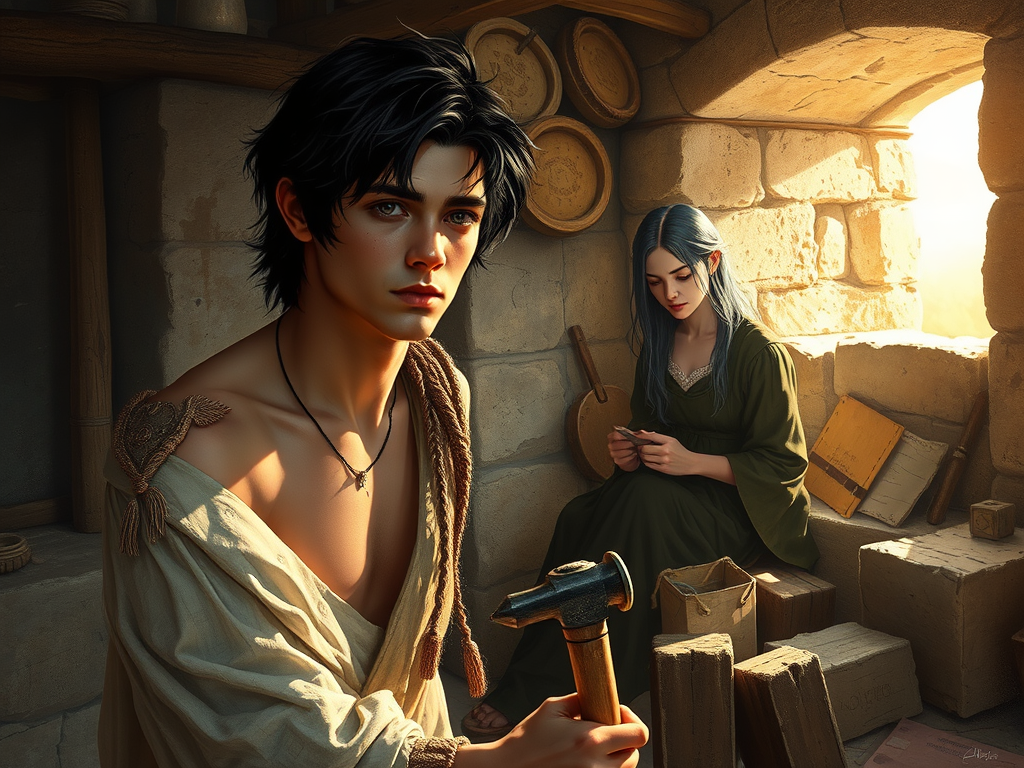
Gall nodded, but his attention had already drifted to the workshop’s open door. Through it, he could see a slice of the street beyond, and the route that would take him past the High-King’s garrison.
“Boy.” Brennan’s voice sharpened. “I asked you a question.”
“Sorry, Master. I was—”
“Somewhere else. As you’ve been every afternoon this week.” Brennan set down his tools with deliberate care. “Your mother came to me begging for this apprenticeship. Said you had potential, that you needed a path away from…” He gestured vaguely. “Whatever life you were heading toward. I took you on because I saw something in you, Gall. But potential means nothing if your mind’s not here.”
Shame burned in Gall’s chest. “It won’t happen again.”
“See that it doesn’t. Now go on, get home before dark. And tell your mother the silver she paid me this month was short. I’ll not mention it again, but I’ll not be cheated either.”
The words struck like a hammer blow. Mother had been carefully counting coins each night by candlelight, her face drawn with worry. If she’d come up short paying Brennan, it meant she’d gone without something essential. Food, most likely.
“I’ll tell her,” Gall said quietly.
He gathered his things and stepped into the cooling evening air. The limp that had plagued him for months after the incident with the guard had finally faded to barely a hitch in his stride. His knee still ached when the weather turned cold, but he could run now. Could climb. Could do what needed to be done.
His feet carried him not toward home, but toward the garrison quarter.
He’d first seen Ekhart again two months after the incident. The recognition had been instant—that hooked nose, that contemptuous bearing, the way he sat his horse as if the very streets belonged to him. Gall had frozen in place, twelve years old again, watching his mother being dragged away. The rage that flooded through him then had been almost holy in its purity.
Since then, he’d made it his business to learn everything about Commander Ekhart of the High-King’s guard.
Now Gall moved through the narrow streets with purpose, slipping into the lengthening shadows as he approached the garrison district. The buildings here were older, more substantial. Stone where the outer quarters made do with wood and daub. Gall found his usual watching post in the mouth of an alley that offered a clear view of the garrison’s main entrance.
He didn’t have to wait long.
Ekhart emerged flanked by two other guards, their mail glinting in the last light of day. They were laughing at something, voices carrying across the empty street. Gall’s hands curled into fists as he watched Ekhart clap one of his companions on the shoulder, jovial and at ease. As if he hadn’t brutalized a starving woman three months ago. As if it had meant nothing.
As if she had meant nothing.
Gall followed at a distance as the three men made their way toward the tavern district. He’d learned Ekhart’s patterns by now—every third evening, drinks at the Silver Standard. At the start of every week, an inspection of the eastern wall. Tuesday mornings, sparring practice in the garrison yard where Gall had once watched through the fence, memorizing the way Ekhart moved, the way he fought.
The commander was skilled, no question. Fast despite his size, with a reach that gave him an advantage over most opponents. But Gall had noticed something else too—a certain recklessness in Ekhart’s fighting style, an eagerness to press the attack that sometimes left him exposed.
That was the opening Gall was looking for.
“You there. Boy.”
Gall’s heart lurched. He’d been too focused on Ekhart, hadn’t noticed the city watchman approaching from the side street. The man was older, gray-bearded, with the weary look of someone nearing the end of a long shift.
“Bit late for you to be out alone, isn’t it?” The watchman’s tone wasn’t unkind, just tired. “Where’s your home?”
“Coppersmith Lane,” Gall lied smoothly. “My master sent me with a message for the garrison. I’m heading back now.”
The watchman studied him for a moment, then waved him on. “Straight home, then. Streets aren’t safe after dark for young ones.”
Gall nodded and hurried away, forcing himself not to look back at the tavern where Ekhart had disappeared. His hands were shaking—from fear of being caught, or from the proximity to his target, he couldn’t say.
When he finally arrived at the cramped room he shared with his mother, she was sitting by the single window, mending a shirt by the last light. She looked up as he entered, and relief flooded her worn features.
“There you are. I was beginning to worry.” She set aside her mending and moved to the small cooking pot over the fire. “There’s stew. Not much, but it’s hot.”
Gall watched her ladle the thin broth into a wooden bowl. She’d lost weight these past months, he realized. Her cheekbones stood out sharply beneath her skin, and her hands trembled slightly as she worked. The bruises Ekhart had left had long since faded, but Gall sometimes caught her touching her throat absently, as if the memory still lingered there.
“Master Brennan says you were short this month,” Gall said quietly.
Her hand froze for just a moment before she continued serving. “Did he? I must have miscounted. I’ll make it right next time.”
“Mother—”
“Eat your stew, Gall. You need your strength for tomorrow’s work.”
He wanted to press her, to demand she tell him what she’d gone without to pay Brennan. But the set of her jaw told him the conversation was closed. Instead, he took the bowl and ate in silence, the watery stew doing little to fill the hollow in his stomach.
That night, lying on his thin pallet while his mother slept fitfully across the room, Gall stared at the ceiling and planned. Three months of watching, of learning, of building his strength. How much longer? Six months? A year?
However long it took.
Ekhart would pay for what he’d done. The man probably didn’t even remember his mother’s face, had likely brutalized a dozen other women since then. But Gall remembered. He remembered everything.
The hammer strike that woke him came not from his dreams but from outside—the city watch calling the hour. Gall rose in the darkness and began his morning exercises, the ones he did in secret before his mother woke. Push-ups until his arms shook. Squats until his legs burned. The grip-strengthening exercises Brennan had taught him, but repeated until his fingers cramped.
He would be ready. Whatever it took, however long it took, he would be strong enough to make Ekhart answer for his crimes.
His mother stirred as the first light crept through their window. She watched him finish his exercises with an expression he couldn’t quite read.
“You’re different,” she said finally. “Since that day. Harder.”
Gall grabbed his work shirt, not meeting her eyes. “I’m older. I’m working. Isn’t that what you wanted?”
“Yes.” But she didn’t sound convinced. “Master Brennan is a good man. The stonemason’s trade is honest work. You could build a real life, Gall. A good life.”
“I know.”
“Do you?” She rose and crossed to him, taking his face in her hands. “Because sometimes I look at you and see…” She trailed off, her eyes searching his. “I see your father.”
The words sent ice through his veins. “You told me my father died fighting the Nagun.”
“I know what I told you.” Her hands dropped away. “But that was a kindness. A lie to give you something to be proud of, some legacy better than the truth.”
“What truth?”
She turned away, moving to stir the breakfast pot, though there was nothing in it yet. “Your father was a thief, Gall. A criminal who chose an easy path over an honest one. He was killed during a robbery gone wrong, his body thrown in a pauper’s grave.” Her voice was flat, drained of emotion. “I lied because I didn’t want you to know. Didn’t want you to think that was your only inheritance.”
Gall stood frozen, his father’s ghost dissolving like smoke. Not a warrior. Not a hero. Just a common thief who’d died as he’d lived—stealing instead of building.
“Why are you telling me this now?”
His mother finally turned to face him. “Because I see that same hunger in you. That same anger. And I’m afraid, Gall. Afraid you’ll make the same choices he did. Afraid you’ll let rage guide you instead of reason.”
“I’m not Father.” The words came out harder than he intended. “I’m not a thief.”
“No. You’re something else. Something I don’t recognize.” She studied him with those sad, knowing eyes. “Just promise me you’ll be careful. Whatever path you’re walking, whatever darkness you’re courting—be careful.”
He wanted to confess everything then. To tell her about Ekhart, about his plans, about the burning need for justice that consumed his every waking thought. But what good would it do? She’d only try to stop him, to protect him from himself.
“I promise,” he lied.
The lie sat bitter on his tongue all the way to Brennan’s workshop.
* * *
The weeks bled into months. Summer’s heat gave way to autumn’s chill, and Gall’s body continued to transform under the twin disciplines of stonework and secret preparation. His shoulders broadened. His arms developed the knotted muscle of someone who spent his days lifting, shaping, striking. The boy who’d been knocked aside by a guard’s riding crop was slowly being replaced by someone harder, stronger, more dangerous.
Master Brennan noticed. “You’ve got the build for this work now,” he said one afternoon, watching Gall maneuver a cornerstone into place. “Another year or two and you’ll be ready to take commissions of your own. Might even take you on as a journeyman if you keep progressing like this.”
It was the highest praise Brennan had ever given him. Gall should have felt pride, satisfaction, hope for the future. Instead, he felt only impatience. A year or two? He’d be nearly sixteen by then. How long was Ekhart supposed to live free and unpunished?
“Thank you, Master,” he said, but his eyes drifted again to the street beyond.
“There you go again.” Brennan’s voice hardened. “Your mind’s elsewhere. Has been for months now. What’s got such a hold on you, boy?”
“Nothing. I’m just—”
“Don’t lie to me. I’ve trained enough apprentices to know when one’s got troubles.” Brennan set down his tools and fixed Gall with a level stare. “Is it a girl?”
“No.”
“Debt? Gangs? Someone threatening you or your mother?”
“It’s nothing like that.”
“Then what?” When Gall didn’t answer, Brennan shook his head. “Stone is patient, Gall. Stone endures. You can’t rush it, can’t force it. You work with its nature, not against it. Same is true for life. Whatever you’re chasing, whatever you think you need to do—patience will serve you better than haste.”
The words were meant as wisdom, but they only stoked the fire in Gall’s chest. Patience. Endurance. All fine principles for a man who hadn’t watched his mother brutalized in the street. Who hadn’t seen her count coins by candlelight, trying to stretch nothing into something. Who hadn’t heard her cough getting worse each night, the wet rattle that said her body was failing even as she insisted she was fine.
“I understand, Master,” Gall said.
But he didn’t. He couldn’t.
That evening, Gall followed Ekhart through the garrison district as the commander made his rounds. The man moved with the casual confidence of someone who’d never had to fear the shadows, never had to watch his back. Why would he? He was untouchable—a commander of the High-King’s guard, armored in mail and authority both.
Gall kept his distance, tracking Ekhart’s path through the evening streets. The commander stopped to speak with other guards, to inspect a merchant’s papers, to bark orders at subordinates who scurried to obey. Each interaction reinforced what Gall already knew: Ekhart was a man of power and position. Bringing him down wouldn’t be simple.
But it could be done. It had to be done.
Gall was so focused on his quarry that he almost missed the conversation happening in the alcove ahead.
“—heard it from one of the garrison scribes,” a man’s voice whispered urgently. “The High-King’s guards aren’t just soldiers. They’re Shatain.”
Gall froze, pressing himself against the wall of the nearest building. Two merchants stood in the alcove, heads close together in the way of men sharing dangerous gossip.
“Shatain?” The second merchant’s voice was skeptical. “That’s just stories to frighten children.”
“Is it? Then explain how Commander Ekhart survived that fall from the eastern wall last year. Thirty feet onto stone, and he walked away without a scratch. Explain the rumors about the blades they carry—those strange shadowy things that make men’s hearts quail just to look at them.”
“Coincidence. Luck. Exaggeration.”
“Believe what you want. But I’ve heard the whispers from court. The Shatain are real, and they serve the High-King. Immortal warriors bound to hunt the Forsaken—those angelic creatures that rebel against the Caretakers’ will.”
The second merchant made a warding sign. “You’re speaking heresy now. The Grand Council would have your tongue for such talk.”
“The Grand Council knows the truth even if they won’t speak it openly. Why else would they treat the High-King’s guards with such deference? Such fear?”
Gall’s heart hammered against his ribs. Shatain. Immortal warriors. It had to be superstition, the kind of wild tales that always gathered around powerful men. But that word—immortal—sent a chill through him despite the evening’s warmth.
The merchants moved on, still arguing in hushed tones. Gall remained pressed against the wall, his mind racing. When he finally emerged from his hiding spot, Ekhart had vanished into the crowd.
It didn’t matter. Gall knew where the commander would be tomorrow.
He walked home slowly, turning over what he’d heard. Shatain. Immortal. Demonic. Even if there was truth to the rumors, what did it change? Ekhart had still harmed his mother. Still deserved to answer for his crimes.
Though a small voice in the back of Gall’s mind whispered: How do you kill something that can’t die?
He pushed the thought away. Superstition and fear, nothing more. Ekhart bled like any man—Gall had seen him cut during sparring practice, had watched him bandage minor wounds. Whatever stories people told themselves about the High-King’s guards, they were still human underneath the mail and authority.
They had to be.
When Gall arrived home, he found his mother hunched over by the fireplace, coughing so hard her whole body shook. The sound was wet and ragged, and when she finally caught her breath, she wiped her mouth with a rag. Gall saw the crimson stain before she could hide it.
“Mother—”
“It’s nothing.” She tucked the bloody rag into her sleeve and tried to smile. “Just the autumn chill getting into my lungs. It’ll pass.”
But they both knew it wouldn’t. Gall had seen enough sickness in the poor quarters to recognize consumption when he heard it. The disease was a slow executioner, patient and merciless.
“You should see a healer,” he said.
“With what coin?” She laughed bitterly. “The good healers charge more than we make in a month, and the poor ones are as likely to poison you as cure you. No, I’ll take my chances with time and rest.”
Time she didn’t have. Rest that wouldn’t come while she spent her nights mending clothes for a few coppers, her days washing laundry until her hands cracked and bled.
Gall crossed to their small chest and pulled out the meager savings they’d managed to accumulate. “Here. Take this to Master Brennan tomorrow. Pay him what you owe, and use the rest for a healer.”
“Absolutely not. That’s for your apprenticeship, for your future—”
“What future will I have if you’re dead?”
The words came out harsher than he’d intended. His mother flinched as if he’d struck her.
“I’m sorry,” Gall said quickly. “I just mean… please. See a healer.”
She took the coins with trembling fingers, and for a moment he thought she might argue further. Instead, she just nodded, exhaustion etched into every line of her face. “You’re a good son, Gall. Better than I deserve.”
If only she knew.
That night, Gall lay awake and did the calculations. Even if the healer could help, even if his mother’s illness could be slowed, they were running out of time and money both. Master Brennan’s apprenticeship fee. Food. Rent on their single cramped room. Medicine now, if the healer demanded ongoing treatment.
The numbers didn’t add up. They never had.
In six months, maybe a year, his mother would be gone. Consumed by disease or poverty or both. And Ekhart—the man who’d started their spiral into desperation, who’d brutalized her and paid her in silver like she was nothing more than a whore to be used and discarded—Ekhart would still be alive. Still powerful. Still free.
Unless Gall did something about it.
The decision crystallized in that moment, hard and sharp as the stones he shaped each day. He wouldn’t wait years. Couldn’t wait. His mother was dying, and before she did, Gall would give her one gift: justice. The knowledge that the man who’d harmed her had paid for his crimes.
Even if she never knew it was Gall who’d made it happen.
He began planning in earnest.
* * *
Two months later, on a frost-rimed morning in late autumn, Gall followed Ekhart through the merchant quarter. The commander was alone today. Unusual, but not unprecedented. He seemed to be on some personal errand, moving through the crowded streets without the usual retinue of guards.
This might be Gall’s best chance.
He’d spent weeks preparing. Had stolen a stonemason’s chisel from Brennan’s workshop—not the fine tools, but an old heavy one earmarked for rough work. The weight felt right in his hand, and the point was still sharp enough to pierce leather, maybe even mail if he struck hard enough and true.
His plan was simple: wait for Ekhart to pass through one of the narrow service alleys between the merchant stalls, then strike from behind. A single thrust to the kidney or the base of the skull. Quick and certain. The commander would fall, and Gall would disappear into the crowd before anyone understood what had happened.
It wasn’t elegant. It wasn’t honorable. But honor was a luxury for people who hadn’t watched their mothers cough blood into rags.
Gall’s heart thundered as Ekhart approached the alley Gall had chosen. The commander was just twenty paces away now. Fifteen. Ten.
Then Ekhart turned down a different street entirely, away from the alley.
Gall cursed under his breath and followed, improvising. Fine. There would be other opportunities, other places. He just had to be patient, wait for the right moment—
Ekhart stopped suddenly and turned around.
For one frozen heartbeat, their eyes met. Gall saw the flash of recognition cross the commander’s face, saw the cruel smile that followed.
“Well, well.” Ekhart’s hand rested casually on his sword hilt. “The street rat from last year. I remember you. The one with the crippled leg and the whore mother.”
Rage exploded through Gall’s chest, burning away caution and fear both. His hand tightened on the concealed chisel.
“She’s not—” he started, but Ekhart talked over him.
“Tell me, boy, did she make good use of the silver I gave her? Or did she spend it all on cheap wine and cheaper men?” The commander’s smile widened. “She had a tightness to her, as I recall. Almost worth the trouble.”
Gall’s vision narrowed to a tunnel. Nothing existed except Ekhart’s sneering face, his mocking voice, the absolute need to make him stop talking, stop breathing, stop existing.
He lunged.
The chisel came up in a savage arc, aimed at Ekhart’s throat. The commander moved with shocking speed, one hand deflecting Gall’s wrist while the other drew his sword in a fluid motion. Steel rang against steel as the blade slapped the chisel from Gall’s grip, sending it clattering across the cobblestones.
Before Gall could react, Ekhart’s fist crashed into his stomach, driving the air from his lungs. He doubled over, gasping, and felt the commander’s boot connect with his ribs. The impact sent him sprawling into the alley wall.
“Pathetic.” Ekhart’s sword point came to rest against Gall’s throat. “Did you really think you could harm me with a stonemason’s tool? A child with a stolen chisel?”
Gall tried to speak, but could only wheeze. His ribs screamed where Ekhart had kicked him.
“I should kill you for this,” Ekhart mused, pressing the blade just hard enough to draw a trickle of blood. “Attacking a commander of the High-King’s guard. That’s a hanging offense. Or perhaps I should have you flogged instead. Let you live with the scars as a reminder of your foolishness.”
“Do it,” Gall managed to gasp out. “Kill me.”
Ekhart laughed—a genuine sound of amusement. “Oh, I think not. Death would be too merciful for you, boy. No, I have a better idea.”
He withdrew his sword and sheathed it, then grabbed Gall by the collar and hauled him upright. His face was close now, close enough that Gall could smell wine on his breath.
“I’m going to let you live,” Ekhart said softly. “I’m going to let you walk away from this alley. And I’m going to give you a gift—the knowledge that you tried and failed. That you’re too weak, too slow, too stupid to ever touch me.” His grip tightened. “And every time you see me in the streets, every time you watch me from whatever shadows you’ve been skulking in, you’ll remember this moment. You’ll remember that I could have killed you and chose not to. That your life exists only because I allow it.”
He released Gall with a shove that sent him stumbling backward.
“Run along now, boy. Go back to your dying mother and your honest stonework. Leave vengeance to those strong enough to claim it.”
Gall wanted to attack again, wanted to throw himself at Ekhart with bare hands if necessary. But his body wouldn’t obey. His ribs were screaming, his lungs still struggling for air, and the trickle of blood from his throat reminded him how easily Ekhart could have killed him.
The commander was right. He was too weak. Too slow. Too everything.
Ekhart turned and walked away, not even bothering to look back. Why would he? Gall posed no threat. Was no threat. Just a foolish boy with delusions of justice.
Gall sagged against the alley wall and tried not to cry. Failed.
* * *
He told no one about the confrontation. Not Master Brennan, who noticed his stiff movements and bruised ribs but accepted Gall’s lie about falling from a scaffold. Not his mother, who was too consumed by her own illness to notice her son’s additional injuries.
The shame burned worse than any physical pain. He’d had his chance, his moment, and he’d failed utterly. Ekhart had batted him aside like an annoying insect, then dismissed him as too pathetic to even bother killing.
You’re too weak.
The words echoed in Gall’s mind every waking hour. During his work at the shop, during his secret exercises, during the long nights when sleep wouldn’t come. Too weak. Too slow. Too stupid.
But weakness could be remedied. Speed could be trained. And stupidity—that could be corrected with planning and patience.
Gall stopped his impulsive following of Ekhart through the streets. Instead, he watched from greater distances, took more careful notes, looked for patterns and vulnerabilities he’d missed before. He intensified his training, pushing his body harder, building not just strength but endurance and speed.
And he began asking questions. Carefully, obliquely, never drawing attention to his interest.
He asked Master Brennan about the strange weapons some of the High-King’s guards carried—those blades that seemed to shimmer with shadow.
“Mordblades,” Brennan said, not looking up from his work. “Though I’d advise you not to look at one too closely if you ever see it drawn. They say those weapons can drive men mad with fear just from their presence.”
“But they’re just swords, aren’t they? Steel like any other?”
“I don’t know what they are, boy, and I don’t want to know. The High-King’s business is his own, and his guards are…” Brennan hesitated. “Best left alone. That’s all I’ll say on the matter.”
Gall asked a Magi at the Grand Council temple about the Shatain, couching his question in terms of religious curiosity.
The Magi’s face went pale. “Where did you hear that word?”
“In the market. Some merchants were talking—”
“Merchants gossip like washerwomen, and gossip about such things is dangerous.” The Magi glanced around as if afraid of being overheard. “The Shatain are the High-King’s hunters. They pursue the Forsaken—those Caretakers who rebel against the celestial order. As for what the Shatain are, what they’re capable of…” He shook his head. “Only the High-King and his innermost circle know the truth. And those who find out uninvited tend to disappear.”
The Magi gripped Gall’s shoulder. “Whatever curiosity drives these questions, I urge you to let it die. Some knowledge carries too high a price.”
But Gall couldn’t let it die. Every scrap of information, every whispered rumor, every half-truth added to the picture forming in his mind. The Shatain were more than human, bound by some dark pact to serve the High-King. They wielded weapons of supernatural power. They hunted beings of celestial origin.
And if the rumors were true, they couldn’t be killed by normal means.
Which meant Gall’s chisel attack had been doomed from the start. Even if he’d struck true, even if he’d buried the blade in Ekhart’s heart, the commander might have simply… continued living.
The thought should have been crushing. Should have ended his plans entirely.
Instead, it clarified them.
If normal weapons couldn’t kill Ekhart, then Gall would need something exceptional. And there was only one weapon he knew of that might work: a Mordblade. The very weapon Ekhart carried at his side.
The irony was almost beautiful. To kill a Shatain, Gall would need to take the man’s own supernatural blade and use it against him.
The problem was simple: How did a fifteen-year-old stonemason’s apprentice get close enough to an immortal warrior to steal his weapon and kill him with it?
Gall didn’t have an answer yet. But he had time. His mother’s illness had stabilized somewhat—the healer’s herbs weren’t a cure, but they’d bought her months, maybe longer. And Gall was still growing, still getting stronger.
He would find a way. He had to.
* * *
Six months after his failed attack, Gall stood in Master Brennan’s workshop and realized with sudden clarity that he was going to leave.
Not today, perhaps not even this month. But soon. The stonemason’s life, which his mother had hoped would be his salvation, was becoming a cage. Every day spent shaping stone was a day Ekhart lived free and unpunished. Every hour of honest labor was time wasted when his real work—his real purpose—remained unfinished.
“You’re doing it again,” Brennan said.
Gall blinked, realizing he’d been staring into space while the master spoke. “I’m sorry. What did you say?”
Brennan set down his tools with a heavy sigh. “I said you’ve learned everything I can teach you at this stage. You’re ready to move on to journeyman work, to start taking your own commissions. This is what we’ve been building toward, Gall. Your future as a master stonemason.”
He should have felt pride. Gratitude. Hope.
He felt nothing.
“Thank you, Master,” Gall said, the words automatic.
“You don’t care, do you?” Brennan’s voice wasn’t angry, just sad. “I’ve watched you this past year, watched you go through the motions. You do the work, you do it well, but your heart’s not in it. It’s somewhere else. Something else.”
Gall met his master’s eyes and saw genuine concern there. Brennan had been kind to him, patient, and had offered him a path to a better life. The man deserved honesty, even if Gall couldn’t give him the whole truth.
“I’m grateful for everything you’ve taught me,” Gall said carefully. “You’ve shown me more kindness than I had any right to expect. But you’re right. My heart isn’t in this work.”
“Then where is it?”
“Somewhere I shouldn’t go. Chasing something I shouldn’t chase.”
Brennan was quiet for a long moment. When he finally spoke, his voice was heavy with resignation. “It’s revenge, isn’t it? Someone hurt you or your mother, and you’re planning to make them pay.”
Gall didn’t answer, but his silence was confirmation enough.
“I thought as much.” Brennan ran a hand through his graying hair. “I saw that hunger in you from the start, that anger beneath the surface. Hoped the work would burn it out of you, channel it into something constructive. Stone doesn’t lie, Gall. It doesn’t deceive or betray. You put in honest labor, you get honest results. I’d hoped that truth would be enough for you.”
“It should have been,” Gall said quietly. “You’ve been a good master. A good man. But some debts have to be paid.”
“At what cost? Your future? Your soul?” Brennan moved closer, his expression fierce. “Listen to me, boy. I’ve lived long enough to see men consumed by vengeance. It’s a fire that burns hotter and hotter until there’s nothing left but ash. Whatever was done to you, whatever injustice you’re carrying—it’s not worth destroying yourself over.”
“You don’t understand—”
“I understand better than you think. You believe revenge will make you whole, will restore something that was taken. But it won’t. It’ll hollow you out, leave you more damaged than you started. The only way forward is to build something new, something better. That’s what I’ve been trying to show you.”
Gall wanted to argue, to make Brennan understand why this was different, why Ekhart had to pay. But how could he explain the sight of his mother’s bruised face, the sound of her coughing blood in the night, the knowledge that she was dying in part because of what that man had done?
“I should go,” Gall said finally.
“Yes,” Brennan agreed. “You should. Take the rest of the day. Clear your head. And tomorrow, come back and tell me whether you’re going to stay and become a stonemason, or whether you’re going to throw it all away chasing ghosts.”
Gall nodded and gathered his things. As he reached the workshop door, Brennan called after him.
“One more thing. Whatever you’re planning, whatever darkness you’re courting—it will change you, Gall. The boy who picks up a weapon in anger is never the same as the boy who puts it down. Be very certain the change is one you can live with.”
The words followed Gall into the street, echoing in his mind as he walked home through the autumn evening. The boy who picks up a weapon. The boy who put it down.
But Gall had already picked up that weapon when he’d seized the chisel and lunged at Ekhart. The only question now was whether he’d strike true when his next chance came.
He arrived home to find his mother sitting by the window, mending as always. She looked up and smiled, but the expression didn’t reach her eyes.
“Gall. You’re early.”
“Master Brennan sent me home.” He crossed to her and knelt beside her chair. “Mother, I need to tell you something.”
She set aside her mending, and he saw fear flicker across her face. “What is it?”
“I’m going to leave the apprenticeship. Soon. Maybe tomorrow.”
“No.” The word was sharp, almost a gasp. “Gall, you can’t. That apprenticeship is your future, your chance at a real life—”
“It’s not the life I want.”
“Then what life do you want? What could possibly be worth—” She stopped herself, studying his face. “It’s him. The guard. Ekhart. You’ve been planning something all this time.”
Gall froze. “How did you—”
“I’m your mother. Did you think I wouldn’t notice? The way you disappear some evenings, come home late with that look in your eyes. The questions you’ve been asking about the High-King’s guards, the Shatain, those damned shadow blades they carry.” Her voice broke. “I knew. I’ve always known.”
“Then you understand why I have to do this.”
“No!” She grabbed his face in both hands, forcing him to meet her eyes. “I understand that you’re my son and you’re about to destroy yourself for my sake. That’s what I understand.”
“He hurt you—”
“He did. And I’ve lived with it, carried it, made my peace with it as best I can. But I won’t let you ruin yourself trying to avenge me. I won’t have that on my conscience when I’m gone.”
The casual mention of her death hit him like a blow. “You’re not going anywhere. The healer’s herbs—”
“Are buying me time, nothing more. We both know that.” She released his face and sank back in her chair, suddenly looking decades older. “I’m dying, Gall. Slowly, but surely. And before I go, I need to know that my son has a future. That he’ll live, build, and maybe even be happy. I need to know that my death won’t be the end of everything I’ve fought for.”
“What about justice?”
“Justice?” She laughed bitterly. “There’s no justice in this world for people like us. Only survival. Only small moments of grace and dignity we manage to carve out despite everything trying to grind us down. That’s what I want for you—not justice, but life. A real life.”
Gall stood and moved to the window, staring out at the darkening street. “I can’t let it go, Mother. I’ve tried. Gods know I’ve tried. But every time I see him, every time I think about what he did, I feel like I’m going to explode. Like if I don’t do something, I’ll tear myself apart from the inside.”
“Then you’re already letting him win.” Her voice was gentle but firm. “He took an hour of my life that night. An hour of pain and humiliation. But if you let your rage over that hour consume the rest of your years, then he’s taken everything. From both of us.”
“It’s not just that hour. It’s everything that came after. The silver coins felt like a brand. The way you flinch when armored men pass in the street. The fact that we’re starving because you gave up food to pay for my apprenticeship, and we’re only starving because we were desperate enough for you to…” He couldn’t finish the sentence.
“To sell my body for a handful of coins?” She stood and joined him at the window. “Yes. I did that. Not because Ekhart forced me—though he certainly gave me no choice—but because my son needed food and a future. And I’d do it again, Gall. A thousand times over. That’s what mothers do.”
“It’s not right.”
“No. It’s not. But pursuing Ekhart won’t make it right. It’ll only add more wrong to the pile.”
They stood together in silence, watching the city lights begin to flicker to life below. Gall felt torn in two—part of him wanted to listen to his mother, to take Brennan’s offer, to build an honest life from the ruins of their circumstances.
But another part, the part that had been growing stronger for the past year, whispered that some debts could only be paid in blood. That letting Ekhart live free was a wound that would never heal, a poison that would taint everything else Gall tried to build.
“I’ll think about what you’ve said,” Gall told her finally. “I promise.”
It was the best he could offer, and they both knew it wasn’t enough.
That night, Gall dreamed of his father. Not the warrior hero his mother had invented, but the thief she’d finally admitted he was. In the dream, his father stood in a dark alley with a knife in his hand, waiting for a merchant to pass. But when the merchant came, it wasn’t a stranger—it was Gall himself, older and worn, carrying a mason’s tools.
His father lunged. The knife flashed. And Gall-the-merchant collapsed bleeding on the cobblestones while Gall-the-dreamer watched helplessly from the shadows.
When his father’s face came into the light, it wasn’t a stranger’s features Gall saw.
It was his own.
He woke with a gasp, sweat-soaked and shaking. Across the room, his mother slept fitfully, her breathing harsh and labored even in rest. The sound of her struggling lungs was a countdown, each breath marking time toward an inevitable end.
Gall rose and moved to the window, staring out at the pre-dawn darkness. Somewhere in this city, Ekhart slept in comfort and security, untouched by conscience or consequence. The man probably didn’t even remember his mother’s name.
But Gall remembered. He remembered everything.
And despite his mother’s pleas, despite Brennan’s wisdom, despite his own dreams warning him away from this path—Gall knew he would see it through.
Some fires, once lit, could not be extinguished. They could only burn.
 Greg C. Miller, Author