Dragon Heartstone > Chapter 48–The Western Wall
“Let it begin,” Quorous ordered, a smirk playing at the corner of his mouth. The Council’s gold weighed heavily on his mind, particularly how much more the spoils of war would be when the city fell. The war drums thundered, their rhythm matching the quickening pulse in the mercenary’s veins. With their blood-red banners snapping in the late afternoon breeze, the Council’s mercenary troops moved forward in square formations, the scrape of hundreds of boots raising dust that caught in the throat.
Moving forward into the dry moat, the men stopped and raised their shields over their heads. Rocks and spears, and occasional arrows rained down upon them, the impacts reverberating through the shields with dull thuds. Most bounced harmlessly off the steel-reinforced wood. The mass of men with their upraised shields formed a crude bridge across the moat.
Within moments, a second wave of mercenaries came bounding after the first and deftly sprinted across the raised shields of the first group. The slap of leather boots on the shields competed with the grunts and curses of the men underneath as they strained to support their comrades’ weight. The second group carried long poles with notches in the sides and a long Y-shaped hook at the upper end. With a heave, the pole’s hook grabbed hold of the upper lip of the outer wall, the scrape of metal on stone setting teeth on edge. The pole carriers anchored the reinforced ends in the dry moat, muscles straining as they held them steady.
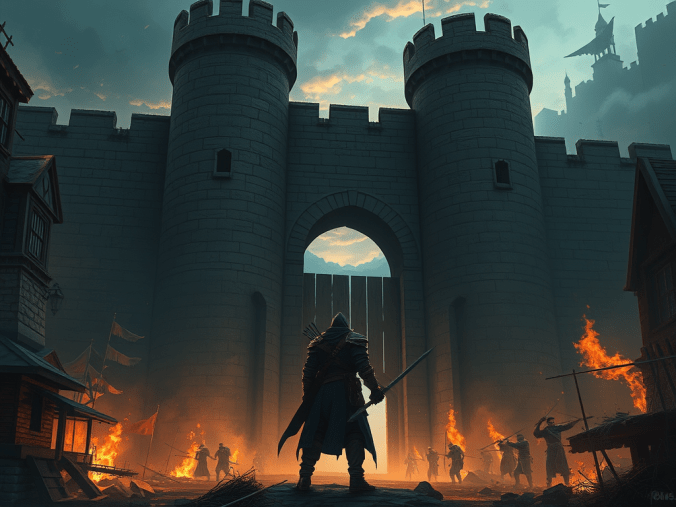
As they did this, a third wave of mercenaries marched forward, carrying crossbows. Four ranks deep, they came to a halt twenty yards shy of the moat. The first two ranks knelt in the dirt, with the second two standing. All raised their weapons, the mechanical clicks of cocking mechanisms creating a symphony of impending death.
Quorous crouched behind a metal shield, chewing on a stick of dried meat. He cared little how many of his men died—they were paid to fight, weren’t they? Besides fewer survivors meant fewer to share the spoils with. He raised his arm, the gold insignia on his sleeve catching the fading sunlight.
With a wave of his hand, a volley of bolts sailed upward at the defenders. Screams and shouts accompanied the dull thuds of bodies toppling over both sides of the walls, the sickening crunch of bone meeting stone carried on the wind. A trumpet blew, its brassy note cutting through the chaos, and the soldiers in the moat, like a well-oiled machine, grabbed hold of the poles and moved along them like ants on a discarded piece of food, using the notches for footholds.
The Bretagne garrison troops rose and fired a volley of arrows at the climbers, the whizzing shafts piercing soft armor, lancing into exposed flesh. Many climbers fell, their screams cutting short as they hit the ground below, but still the enemy advanced. A mercenary with a long-pleated beard leaped from the pole onto the ramparts, pulled two short swords out, and quickly dispatched the garrison soldiers defending the area. Blood sprayed in fine mists that caught the late afternoon light. Soon, a steady stream of attackers piled onto the bulwark, fanning out in both directions, their war cries mingling with the desperate shouts of the defenders.
* * *
Gall raced up the rampart, with Riasean behind him, just as more mercenaries leaped over the wall. The stench of blood and fear hung thick in the air. He glanced at the city behind him—beyond the outer wall lay the homes and shops of the common folk, and beyond that, the inner keep. If they lost the outer wall, they’d be forced to retreat to the keep, where escape would be impossible. They’d be trapped and slaughtered when the Council’s forces finally broke into the inner keep.
His hand twitched toward his Mordblade, but he resisted. Using it here would betray secrets he couldn’t afford to reveal. Instead, he picked up a discarded sword, feeling its unfamiliar weight. The bearded mercenary lunged toward him, his swords scything through the air with deadly whispers. Sliding, Gall dipped under the man and thrust upward, burying his blade to the hilt. Hot blood cascaded over his hands as the man’s final breath rattled in his chest. With a toss, he hurled the man’s body back onto those behind him, rewarded with grunts and curses as they stumbled.
Grabbing the pole’s hook, he lifted the mechanism off the wall, muscles burning with the effort. With a grunt, he tossed the pole backward onto the attackers below. The distant crack of bones and screams told him his aim had been true. Several of the mercenaries who had climbed after the first turned and rushed him, hatred burning in their eyes. Something whipped past his head, and two attackers fell gurgling, their throats gouged by small throwing knives. Blood fountained from severed arteries, spraying across the stonework in crimson arcs. Gall glanced sideways and spotted Riasean, who swiftly pulled his short sword and stepped past him to engage the enemy.
“Save your fancy blades,” Gall shouted over the din of battle. “We’ve got a long fight ahead!”
Another volley of bolts sailed across the top of the wall, momentarily darkening the sky. A sharp, stabbing pain erupted in Gall’s shoulder, white-hot and searing. He glanced down. A haft protruded, the wooden shaft slick with his blood. Seizing the bolt with his fingers, he ripped the weapon out, grinding his teeth against the tearing sensation. Blood poured down his side, warm and sticky against his skin. Even so, the pain began to subside in waves as his regenerative capabilities started manifesting, the torn flesh knitting itself together with slow but inevitable speed.
For what felt like an eternity, attackers flung themselves at the outer walls. The sun dipped lower, casting long shadows across the battlefield as the garrison’s numbers dwindled. Gall’s arms grew heavy, and his breathing labored despite his healing abilities. The metallic tang of blood coated his tongue, and his ears rang with the constant clash of steel on steel. A piercing horn sounded from the southwest, drawing his attention to a new threat.
Corpses littered the ramparts, defenders and attackers alike, their blood running in rivulets between the stones. The mercenaries relentlessly pressed forward, driven by an unknown mania.
Gall looked down as two groups of mercenaries converged on the southwest wall, their helmeted forms bobbing like gnats in the gathering dusk. “They’re targeting the gatehouse,” he called out, voice hoarse from shouting commands. He turned to Riasean and said, “Secure that gatehouse; otherwise, the lower wall will be lost.” And with it, their escape route to the inner keep. They would be trapped when the Council’s forces finally broke through. The lower walls would become their tomb.
Riasean nodded grimly, understanding without words what was at stake. “I’ll take ten men. Hold this section—we can’t afford to lose both.”
As Riasean disappeared down the steps, Gall gripped his borrowed sword tighter, ignoring the throbbing in his shoulder. Daylight hung like a thread, and survival seemed like a distant hope fading with the light.
But a grinding sound echoed through the streets before Riasean could reach the bottom of the rampart. Gall’s heart sank as he recognized it—the southwest gate portcullis was being raised. That could only mean one thing. Infiltrators had gotten into the gatehouse. Below, a trumpet sounded from outside the city, its brassy note carrying a command rather than a warning.
A ragged column of Cazidoran conscripts stormed through the outer gate, their thin frames and mismatched armor revealing their forced service. The last rays of sunlight glinted off their rusted weapons as they charged forward, their faces a mixture of fear and desperate determination. Gall could see the whip marks on some of their backs—these men fought not for coin or glory but under the threat of death from their own commanders.
A wave of arrows arced through the air from the garrison bowmen, slaughtering the lead ranks. The conscripts stumbled over their fallen comrades, wavering like wheat in a storm. Blood pooled between the cobblestones as men fell, their screams rising above the battle’s din.
A shrill cry cut the air, piercing enough to make Gall wince. The thundering of hoofbeats echoed down the cobblestone streets from both directions, the rhythmic clopping amplified by the narrow passages. Paulis and his garrison cavalry appeared as if from nowhere, their mounts’ flanks lathered with sweat. They scythed through the disorderly mob, their sabers flashing in the dying light. Each swing claimed a life, filling the streets with bodies and streams of blood that ran like dark rivers in the twilight.
* * *
Riasean, seeing his chance, dodged through the melee. He slipped into the shadows at the edge of the battle, his nimble feet carrying him over bodies and around clashing swordsmen. With a final sprint, he ducked into the gatehouse, the heavy wooden door slamming behind him.
Two mercenaries jumped him when he entered, their eyes wild with bloodlust. Riasean’s blade flashed, almost too fast to see. He killed one instantly with a knife thrust to the heart, the man’s eyes widening in surprise as he fell. The second lunged forward, but Riasean sidestepped, dropping his knife to free both hands. He seized the man’s head and, with a savage twist, crushed his throat. While the man gurgled desperately for air, clawing at his ruined windpipe, Riasean stepped over him and grabbed the gatehouse winch.
Muscles straining, sweat pouring down his face, he cranked the mechanism. The portcullis began to lower, its iron teeth descending like a beast’s maw. Outside, the conscripts realized their retreat was being cut off. Some tried to surge forward, only to meet the garrison’s steel. Others tried to flee back the way they had come, but the portcullis slammed down with a resounding clang, trapping them in a killing field.
Pounding footsteps announced the arrival of reinforcements. City men rushed into the gatehouse; their faces grim but determined. Together, they helped Riasean jam the portcullis winch and secure the outer doors. The sound of bars dropping into place echoed like a death knell for those trapped by the lowered portcullis.
Gall appeared moments later, his clothing drenched with blood. He inspected the barred gatehouse doors and then turned to Riasean. “We held them. For now.” His voice was quiet, almost lost in the diminishing sounds of battle outside.
Riasean cleaned blood from a knife on his sleeve, his eyes dark with knowledge of what must come next. “Yes, but we can’t stop another attack on the outer walls. We must fall back to the inner keep.”
* * *
As the afternoon waned into evening, shadows lengthened across the blood-soaked streets. The defenders’ respite was brief. More attackers spilled onto the walls, their silhouettes dark against the purple sky. Gall caught Riasean’s eye across the courtyard and nodded grimly. He turned to the heralds standing ready nearby and gave a sharp command.
Trumpets punctured the air with mournful notes—the signal to abandon the outer walls. Defenders slipped away from their positions, moving in disciplined groups toward the inner keep. The wounded were carried by their comrades, leaving trails of blood that gleamed black in the fading light.
The mercenaries, sensing the defenders retreat, pressed their advantage. They again breached the gatehouse doors, the wood splintering under their assault. Slowly but inevitably, the portcullis rose, allowing conscripts and mercenaries to pour through the southwestern gate in a human tide, their war cries filling the air. They surged forward, only to meet a hail of arrows from atop the inner keep walls. The projectiles tore into the front ranks, dropping men like autumn leaves.
The Council troops quickly scattered, seeking shelter in the buildings next to the wall, ducking behind corners and into doorways. The narrow streets became a deadly maze as the defenders’ arrows found those foolish enough to expose themselves.
* * *
From his vantage point, Quorous stared up at the tall inner keep walls, his earlier confidence fading like daylight. They were too tall for the climbing poles. Rams would be needed to breach the gates, but those were still outside the city, and to get them near the inner keep meant pushing them through dangerous and congested streets in the lower city.
His men scurried through the streets, securing buildings and corners, but found their progress halted. In both directions from the breached gate, they found the roads blocked by flaming debris and makeshift barricades set ablaze by the retreating defenders. Behind these fiery obstacles, garrison archers accurately struck those foolish enough to approach, their arrows finding targets even in the growing darkness.
The mercenary commander wiped the sweat from his brow, his face illuminated by the distant fires. This was not the easy victory he had promised the Council. The casualties were mounting, which was troublesome, not so much because of the blood sacrifice but because it made victory more difficult. He would need to demand a higher percentage for the city’s capture.
It was too dark to push the attack now. The narrow streets would become a slaughterhouse since his men were unfamiliar with the layout and the defenders knew every corner. They would resume in the morning after his scouts had mapped alternate routes to the inner keep.
An uneasy calm settled on the city as both sides rested. The only sounds were the crackling of fires, the moans of the wounded, and the occasional shout of a sentry. In the distance, the inner keep stood like a dark mountain against the night sky, its walls a portent of a much bloodier battle to come.
* * *
Gall sat in the flickering candlelight; his weathered face lined with exhaustion as he stared out at the burning fires in the portion of the lower city controlled by the Council. The acrid smell of smoke drifted through the open window, mingling with the mustiness of the ancient stone chamber. In the distance, screams and the clash of metal occasionally pierced the night. Harald and Paulis shared a bottle of wine, the rich burgundy liquid sloshing against the sides of their cups as they poured.
“Another day like this will undo us,” Paulis said, exhaustion in his voice. His usually immaculate uniform was smudged with soot, and a thin cut ran across his left cheek.
“Any word yet from the Queen?” Gall asked Harald, his fingers drumming anxiously on the rough-hewn table.
Harald shook his head, his broad shoulders slumping. “The last I heard, she was at least a day’s march from here. We are still on our own.” He stood and turned away from the window, the chainmail beneath his tunic clinking softly with the movement.
The door creaked open, and a sentry, his face streaked with dirt and sweat, addressed Harald. “Sir, you must come and see this.” Urgency in his voice cut through the heavy atmosphere of the room.
Harald turned toward the doorway, reaching for the sword at his hip. “What is it?”
“Another army approaches from the north,” he said, his breath coming in short gasps. Gall and Paulis sat upright and looked at each other, the momentary hope in their eyes visible even in the dim light.
“Could the Queen have reached us?” Paulis asked, setting down his cup with a sharp click on the table.
“Let’s go see,” Harald said. The three men followed the sentry toward the north curtain wall, their boots echoing against the stone steps as they climbed.
When they reached the top of the wall, the night air was cold and damp. The smell of smoke was more pungent here, and the moans of the wounded from the makeshift infirmary below carried up to them. They looked across the Landrosian plain, where a thin line of torches wavered in the darkness like fireflies, marking the progress of troops moving across the terrain.
“How odd,” Harald said, squinting into the distance, the torchlight reflecting in his eyes. “They come from the northwest, along the Nathair river valley, and not the road from Keihl.”
Gall shook his head, his dark beard catching the moonlight. “That cannot be Britta; she would be coming from the north road. In that direction lies the Dwarf lands and the northern part of Cazidor. My best guess is that another Cazidoran force is approaching us from the north.” His voice was grim, and his knuckles whitened as he gripped the cold stone of the battlement.
Paulis turned to his aide, his face tightening with resolve. “Alert the guards to expect an attack from the north now. Keep the gates locked.” But even as he said this, a rider galloped up to the gates, the thundering hooves echoing across the courtyard. The rider was dressed in light gray and bore a flag of truce that fluttered in the night breeze.
“Open the gates and let us in,” the rider shouted, his voice hoarse and strained as he panted.
Paulis shouted from the gatehouse wall, his voice carrying across the stillness, “Who are you?”
Another rider rode up next to the first, and the two men spoke to each other quietly, their hushed voices not carrying to the wall.
“Enough guessing games,” Paulis called down, his patience wearing thin. “Tell us who you are or be treated as an enemy.”
The second rider pulled back his hood. The torchlight revealed a face with a strong jaw and determined eyes. Gall recognized him instantly, his breath catching in his throat. “I am Ulrich, commander of the Free Cazidoran Army. We come to help defend Bretagne.”
Harald looked at Gall, and the older man smiled, revealing deep lines around his eyes. Paulis shouted to the guards, his voice carrying a new energy. “Open the gates! These are friends of Bretagne.”
The massive wooden gates groaned as they swung open, and within minutes, a long column of light gray uniformed troops rode into the Landros. The steady rhythm of hundreds of hooves on cobblestone filled the air, punctuated by the jingle of armor and weapons. Above them flew a white flag with a yellow lily snapping in the wind.
Ulrich soon joined the war council, the scent of horse and leather clinging to him as he entered the chamber. His armor was battered but well-maintained, and his eyes showed the weariness of long travel. “I’m sorry I could only bring a thousand men,” he said, accepting a cup of wine from Harald. “It took time to gather those who refused to fight under the Council’s banner and bring them through the Dwarf lands.”
Gall spoke, leaning forward in his chair. “The Dwarfs let you pass through their lands? That is unusual.” His eyebrows rose in surprise.
“We had a very vocal advocate amongst them: your friend Vig,” Ulrich replied with a hint of a smile.
Gall brightened, his eyes widening as he straightened in his chair. “Ah, so that is what happened to that reprobate.” He laughed; a sound that hadn’t been heard in the chamber for days. “I knew it would take more than an assassination attempt to kill him.” He clasped Ulrich on the shoulder, his grip firm and grateful. “Your help means more to us than sheer numbers. It gives us hope that we can last tomorrow.”
“We will do whatever we can to help you,” Ulrich replied, his voice firm and determined.
Paulis spoke now, rising from his seat, the chair scraping against the stone floor. “Come with me then, young man. I have a job for you.” He turned and left the room, his footsteps purposeful, with Ulrich following close behind.
Harald looked at Gall in the renewed silence, the distant sounds of the fighting a constant backdrop. “It is good to have friends, is it not?”
“Yes,” Gall replied, his gaze returning to the window where the fires still burned in the lower city. “But we need more than a few friends. We need the Bretagne Army.” He sighed deeply; the weight of responsibility evident in his slumped shoulders. “Even with Ulrich’s men, we may only be able to hold what we have.”
Outside, the wind shifted, carrying the last sounds Ulrich’s men making their way into the city—a reminder that the night was far from over and tomorrow would bring new battles to fight.
 Greg C. Miller, Author